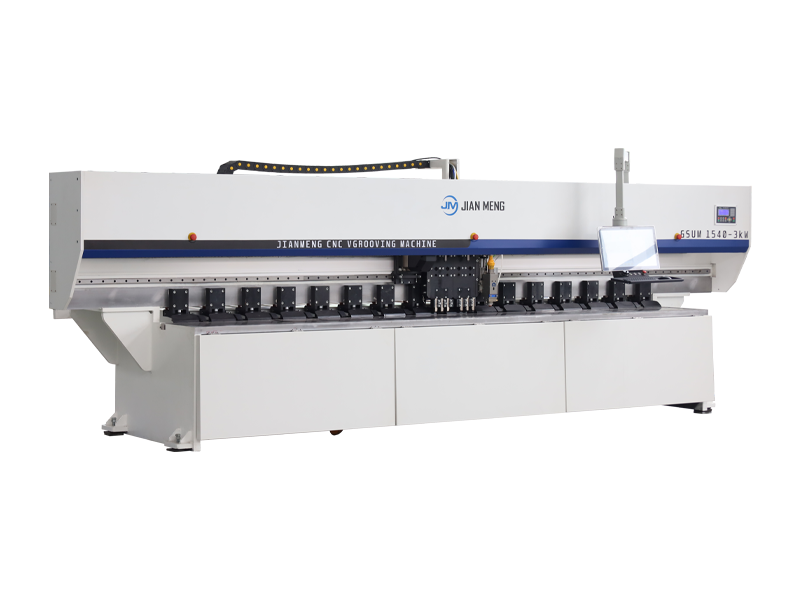
A Vertical & Laser Combo Machine (also referred to as vertical laser composite machine or vertical mechanical-laser integrated processing machine) is an advanced precision processing equipment that integrates vertical mechanical processing (such as V-grooving, beveling, and chamfering) with laser cutting/engraving technology. It is widely applied in metalworking, sheet metal fabrication, aerospace, automotive, and precision component manufacturing industries, designed to complete multiple processing tasks (mechanical grooving + laser cutting/engraving) in a single setup. Unlike standalone vertical mechanical machines or laser cutting machines, this combo equipment combines the advantages of high mechanical processing stability and laser processing precision, addressing the limitations of single-process equipment—such as low efficiency of separate processing, poor consistency of workpiece positioning, and high labor costs. This article systematically elaborates on the definition, core working principles, main types, typical application scenarios, process optimization, and maintenance guidelines of Vertical & Laser Combo Machines, integrating practical technical parameters and industry operational experience to provide comprehensive guidance for engineers, production managers, quality control personnel, and maintenance technicians.
I. Overview and Core Definition of Vertical & Laser Combo Machines
In modern manufacturing, many workpieces require both mechanical processing (e.g., precise V-grooves for bending and assembly) and laser processing (e.g., fine cutting, marking, or engraving for functional or aesthetic purposes). For example, automotive decorative panels need V-grooves for bending and laser marking for part numbers; aerospace components require precise mechanical beveling and laser engraving for traceability codes. Traditional processing methods rely on separate vertical mechanical machines and laser equipment, which involve repeated workpiece clamping, positioning, and transfer, leading to low production efficiency, poor processing consistency, and increased risk of workpiece deformation.
A
Vertical & Laser Combo Machine solves these pain points by integrating vertical mechanical processing units (e.g., V-grooving spindle, beveling tool) and laser processing units (e.g., fiber laser, CO2 laser) into a single vertical structure. The workpiece is clamped once on the horizontal worktable, and the machine automatically switches between mechanical and laser processing modules to complete all required tasks. The vertical design ensures stable processing, easy workpiece loading and unloading, and optimal space utilization, while the integration of dual processing technologies enables high precision, high efficiency, and multi-functionality.
The core features of Vertical & Laser Combo Machines include: integrated mechanical and laser processing modules, vertical structural design, high-precision positioning system (usually with linear guides and servo motors), CNC control for automatic process switching, and compatibility with a wide range of materials. Key performance indicators include mechanical processing accuracy (groove angle ±0.05°–±0.1°, depth precision ±0.02mm–±0.05mm), laser processing accuracy (cutting accuracy ±0.01mm–±0.03mm), processing speed, and tool/laser life. Advanced models are equipped with intelligent control systems, enabling automatic parameter adjustment, real-time processing monitoring, and seamless integration into automated production lines.
II. Core Working Principle of Vertical & Laser Combo Machines
The operation of a Vertical & Laser Combo Machine is based on the integration of precision mechanical cutting and laser processing principles. The machine completes processing tasks through coordinated work of the mechanical processing unit, laser processing unit, workpiece clamping system, and CNC control system. The entire working process can be divided into six key stages, ensuring efficient, precise, and continuous processing:
1. Workpiece Fixing and Positioning
The workpiece is placed horizontally on the machine’s high-precision worktable, which is equipped with an automatic clamping system (hydraulic, pneumatic, or electric clamps) to fix the workpiece firmly. The clamping force is adjustable according to the workpiece material, thickness, and processing requirements to avoid movement or deformation during mechanical or laser processing. For thin, delicate, or high-precision workpieces, soft clamping pads or vacuum adsorption systems are used to prevent surface scratches or damage. The CNC system automatically positions the workpiece using a positioning sensor (such as a laser positioning sensor or CCD camera) to ensure accurate alignment of the processing path with the workpiece’s target position.
2. Processing Parameter Setting
The operator inputs the processing parameters into the CNC control system, including mechanical processing parameters (groove angle, depth, feed rate, spindle speed) and laser processing parameters (laser power, pulse frequency, cutting speed, engraving depth). The system automatically matches the parameters according to the workpiece material (e.g., steel, stainless steel, aluminum, composite materials) and processing requirements, and stores the parameter sets for future reuse. Advanced models support parameter optimization based on workpiece characteristics, ensuring optimal processing results.
3. Mechanical Processing Stage
The CNC system controls the vertical mechanical processing unit (equipped with V-grooving tools, beveling tools, or chamfering tools) to move to the target position. The spindle drives the mechanical tool to rotate at a high speed (usually 1000–6000 rpm), and the worktable or tool moves linearly along the preset path to complete mechanical processing (e.g., V-grooving, beveling). For deep grooves or complex mechanical processing, multiple passes may be required, with each pass removing a small amount of material to avoid tool damage and workpiece deformation. Cutting fluid is used during mechanical processing to cool the tool and workpiece, reduce friction, and flush away cutting chips.
4. Processing Module Switching
After completing mechanical processing, the machine automatically switches to the laser processing module. The mechanical tool is retracted to the safe position, and the laser processing unit (laser head, focusing lens) moves to the target position under the control of the CNC system. The laser system is activated, and the focusing lens adjusts the laser beam to the required spot size to ensure precise laser processing. The switching process is fully automated, reducing manual intervention and improving processing efficiency.
5. Laser Processing Stage
The laser processing unit emits a high-energy laser beam (fiber laser for metal materials, CO2 laser for non-metallic materials) to process the workpiece. Depending on the requirements, the laser can perform fine cutting, marking, engraving, or ablation. For example, laser cutting is used to cut complex shapes on the workpiece after mechanical grooving; laser marking is used to print part numbers, barcodes, or logos; laser engraving is used to create decorative patterns or functional textures. During laser processing, auxiliary gas (such as nitrogen, oxygen, or air) is used to blow away molten material, improve processing quality, and prevent surface oxidation.
6. Processing Completion and Unloading
After completing all processing tasks (mechanical + laser), the machine stops automatically, and the clamping system releases the workpiece. The operator checks the processing quality using tools such as angle gauges, depth gauges, surface roughness testers, and laser measuring instruments to ensure the dimensions and surface quality meet the requirements. The workpiece is then unloaded, and the worktable is cleaned (removing cutting chips, laser slag, and cutting fluid residue) to prepare for the next processing cycle.
III. Main Types of Vertical & Laser Combo Machines and Their Working Principles
Vertical & Laser Combo Machines are classified into various types based on their control mode, laser type, processing capacity, and application scenarios. Each type has unique characteristics, working principles, and applicable fields. The following is a systematic classification and detailed introduction of mainstream Vertical & Laser Combo Machines:
1. Based on Control Mode
1.1 Semi-Automatic Vertical & Laser Combo Machine
This type of machine integrates semi-automatic mechanical processing and laser processing functions. The workpiece loading, unloading, and partial parameter adjustment are completed manually, while the processing process (mechanical cutting, laser processing, and module switching) is automated. It balances processing efficiency and cost, suitable for small-to-medium-batch, medium-precision processing scenarios.
Working Principle: The operator clamps the workpiece manually, inputs the processing parameters into the CNC system, and starts the machine. The system automatically controls the mechanical processing unit to complete V-grooving, beveling, or other mechanical tasks, then switches to the laser processing unit to perform laser cutting, marking, or engraving. After processing, the operator unloads the workpiece and loads a new one. The machine supports simple parameter adjustment and program storage, reducing labor intensity compared to standalone equipment.
Key Advantages: Moderate cost, easy operation, higher efficiency than separate equipment, suitable for small-to-medium-batch processing.Limitations: Requires manual loading and unloading, limited processing precision, not suitable for large-batch or high-precision processing. Best For: Small workshops, medium-batch sheet metal processing, such as decorative panels, small metal parts, and electronic enclosures.
1.2 CNC Vertical & Laser Combo Machine
This is the most advanced type of Vertical & Laser Combo Machine, equipped with a high-precision CNC system (such as FANUC, Siemens, or domestic CNC systems) to realize fully automatic parameter setting, workpiece positioning, processing, and quality inspection. It is suitable for high-precision, large-batch, and complex processing scenarios, widely used in high-end manufacturing fields.
Working Principle: The operator inputs the processing program (including mechanical and laser processing parameters, path planning) into the CNC system. The machine automatically clamps the workpiece using an automatic clamping system, positions the workpiece accurately via sensors, and completes mechanical processing and laser processing in sequence according to the preset program. Advanced models can integrate automatic loading and unloading systems (robotic arms), conveyor lines, and online inspection equipment to realize fully automated production. The CNC system supports multi-task processing, allowing for simultaneous mechanical and laser processing (for different workpieces or different positions of the same workpiece) in some models.
Key Advantages: High processing precision (mechanical processing angle accuracy ±0.05°, laser processing accuracy ±0.01mm), high efficiency, good repeatability, suitable for complex and large-batch processing, easy integration into automated production lines. Limitations: High initial investment and maintenance costs, requiring professional operators. Best For: High-precision sheet metal processing, aerospace parts, automotive precision components, and large-batch production of high-end decorative parts.
2. Based on Laser Type
2.1 Fiber Laser Vertical Combo Machine
This type of machine uses a fiber laser as the laser processing unit, which has the advantages of high energy density, good beam quality, high processing efficiency, and low energy consumption. It is mainly used for processing metal materials (steel, stainless steel, aluminum, copper, and their alloys) and some composite materials.
Working Principle: The fiber laser emits a high-energy laser beam, which is transmitted through an optical fiber to the laser head, and focused into a small spot to process the workpiece. The fiber laser is suitable for fine cutting, marking, and engraving of metal materials, and can be seamlessly integrated with the vertical mechanical processing unit to complete tasks such as V-grooving + laser cutting, beveling + laser marking. The fiber laser’s wavelength (1064nm) is highly absorbed by metal materials, ensuring high processing quality and efficiency.
Key Advantages: High laser processing efficiency, good beam quality, low energy consumption, long service life, suitable for metal material processing. Limitations: Not suitable for non-metallic materials (such as PVC, acrylic). Best For: Metal sheet metal processing, automotive parts, aerospace components, and precision hardware.
2.2 CO2 Laser Vertical Combo Machine
This type of machine uses a CO2 laser as the laser processing unit, which is suitable for processing non-metallic materials (PVC, acrylic, wood-based panels, fabric) and some thin metal materials. It has the advantages of wide material adaptability and low cost.
Working Principle: The CO2 laser emits a laser beam with a wavelength of 10600nm, which is highly absorbed by non-metallic materials, enabling fine cutting, engraving, and marking. The machine integrates a vertical mechanical processing unit (for V-grooving, beveling of non-metallic or thin metal workpieces) and a CO2 laser unit, suitable for processing workpieces that require both mechanical grooving and laser processing, such as decorative non-metallic panels, acrylic signs, and thin metal decorative parts.
Key Advantages: Wide material adaptability, suitable for non-metallic and thin metal processing, moderate cost. Limitations: Lower energy density than fiber lasers, lower processing efficiency for thick metal materials. Best For: Non-metallic material processing, thin metal decorative parts, and signage manufacturing.
2.3 Hybrid Laser Vertical Combo Machine
This type of machine is equipped with both fiber laser and CO2 laser units, enabling processing of both metal and non-metallic materials. It is highly versatile, suitable for complex processing scenarios where multiple materials are involved.
Working Principle: The machine automatically switches between fiber laser and CO2 laser units according to the workpiece material and processing requirements. For metal materials, the fiber laser is used for laser processing; for non-metallic materials, the CO2 laser is used. The vertical mechanical processing unit can process both metal and non-metallic workpieces, realizing multi-material, multi-process integrated processing. This type of machine is equipped with an advanced CNC system to control the switching of laser units and mechanical processing, ensuring processing accuracy and efficiency.
Key Advantages: High versatility, suitable for multi-material processing, reduces the need for multiple equipment, improves production efficiency. Limitations: High cost, complex structure, high maintenance requirements. Best For: Mixed-material processing workshops, high-end decorative manufacturing, and multi-variety, small-batch production.
3. Based on Processing Capacity
3.1 Small-Sized Vertical & Laser Combo Machine
This type of machine has a small worktable size (usually 500mm × 300mm or smaller) and is suitable for processing small workpieces, such as small metal panels, electronic component shells, precision hardware, and small non-metallic signs.
Key Advantages: Compact structure, small space occupation, easy to move and install, suitable for small workshops and laboratories. Limitations: Limited processing size, low laser power (usually 50–150W), not suitable for large workpieces or thick materials. Best For: Small workpieces, precision hardware, electronic components, and small-scale prototype processing.
3.2 Medium-Sized Vertical & Laser Combo Machine
This is the most common type of Vertical & Laser Combo Machine, with a worktable size of 1000mm × 500mm to 2000mm × 1000mm, and laser power of 150–500W. It is suitable for processing medium-sized workpieces, such as metal cabinets, door panels, automotive decorative parts, and medium-sized non-metallic panels.
Key Advantages: Balanced processing capacity and space occupation, suitable for most processing scenarios, moderate cost, adjustable laser power for different materials.Best For: Medium-sized sheet metal parts, batch production of decorative panels, and general manufacturing.
3.3 Large-Sized Vertical & Laser Combo Machine
This type of machine has a large worktable size (more than 2000mm × 1000mm) and high laser power (500W–2000W), suitable for processing large workpieces, such as large metal plates, ship components, building decorative panels, and large non-metallic workpieces.
Key Advantages: Large processing capacity, high laser power, suitable for thick materials and large workpieces, high stability. Limitations: Large space occupation, high cost, complex installation and maintenance. Best For: Large-scale sheet metal processing, building decoration, shipbuilding industry, and large-batch production of large workpieces.
IV. Typical Application Scenarios of Vertical & Laser Combo Machines
Vertical & Laser Combo Machines are widely used in various manufacturing industries, especially in fields requiring both mechanical processing (V-grooving, beveling) and laser processing (cutting, marking, engraving). The integration of dual technologies enables efficient, precise, and multi-functional processing, reducing production costs and improving product quality. The following are typical application scenarios and corresponding machine types:
1. Sheet Metal Fabrication Industry
The sheet metal fabrication industry is the primary application field of Vertical & Laser Combo Machines. Sheet metal parts (such as metal cabinets, enclosures, door panels, and shelves) often require V-grooves for bending and laser marking for part identification or decoration. Vertical & Laser Combo Machines can complete both tasks in a single setup, improving processing efficiency and consistency.
For example, in the production of metal cabinets, the machine first processes V-grooves on the edges of sheet metal plates to facilitate bending into a box shape, then uses laser marking to print the cabinet model and production date. CNC fiber laser vertical combo machines are widely used in large-batch sheet metal production, ensuring consistent groove dimensions and clear laser marks.
2. Automotive Industry
The automotive industry requires a large number of precision sheet metal components (such as body panels, door frames, dashboard brackets, and decorative parts) that need both mechanical processing and laser processing. Vertical & Laser Combo Machines, especially CNC fiber laser models, are used to process these components, ensuring high precision and consistency.
For example, automotive body panels require V-grooves for bending and laser cutting for complex shapes, while automotive decorative parts need beveling and laser engraving for aesthetic effects. Multi-functional vertical combo machines can complete all these tasks in one clamping, reducing workpiece transfer and improving production efficiency. The high precision of the machine ensures the fit and appearance of automotive components, meeting the strict quality standards of the automotive industry.
3. Aerospace Industry
The aerospace industry requires high-precision, high-strength components (such as aircraft structural parts, engine components, and cabin panels) with strict dimensional accuracy and surface quality. These components often require precise mechanical beveling/V-grooving and laser marking/engraving for traceability and functional purposes. Vertical & Laser Combo Machines, especially high-precision CNC models, are ideal for this field.
For example, aircraft cabin panels require precise V-grooves for assembly and weight reduction, and laser marking to print component serial numbers and material information. The machine’s high mechanical precision (angle accuracy ±0.05°, depth precision ±0.02mm) and laser processing precision (±0.01mm) ensure the structural stability and traceability of aerospace components, meeting the high reliability and safety standards of the industry.
4. Building Decoration Industry
The building decoration industry uses Vertical & Laser Combo Machines to process decorative metal panels, aluminum profiles, glass curtain walls, and non-metallic decorative materials (such as acrylic, PVC). These materials often require V-grooves for installation and laser engraving/marking for aesthetic effects.
For example, decorative metal panels for interior and exterior walls require V-grooves to create a seamless appearance and laser engraving to form decorative patterns. Large-sized CO2/fiber hybrid vertical combo machines are used to process large decorative panels, completing both mechanical grooving and laser processing in one setup, improving processing efficiency and quality. For non-metallic decorative materials (such as acrylic signs), the machine uses CO2 laser for engraving and mechanical grooving for edge finishing.
5. Electronic and Precision Hardware Industry
The electronic and precision hardware industry requires small, high-precision components (such as electronic enclosures, connector shells, and precision brackets) that need both mechanical processing (V-grooving, chamfering) and laser marking (part numbers, barcodes). Small-sized CNC fiber laser vertical combo machines are used to process these components, ensuring high precision and repeatability.
For example, electronic enclosures require V-grooves to facilitate the assembly of covers and internal components, and laser marking to print product models and batch numbers. The machine’s compact structure and high precision make it suitable for small workpieces, reducing production space and improving processing efficiency.
6. Other Fields
- Composite Material Processing: Vertical & Laser Combo Machines are used to process composite materials (such as carbon fiber composites, fiberglass composites) for aerospace and automotive components. The mechanical unit processes V-grooves for assembly, and the laser unit performs cutting or marking, ensuring precise processing and structural stability.
- Signage and Advertising Industry: Used to process metal and non-metallic signs, including mechanical grooving for edge finishing and laser engraving/marking for text and patterns. CO2 laser vertical combo machines are widely used in this field for their wide material adaptability.
- Mold Manufacturing Industry: Used to process mold surfaces and cores, including mechanical beveling and laser engraving for mold identification and functional textures, ensuring the quality of injection-molded or die-cast products.
V. Vertical & Laser Combo Machine Process Optimization and Selection Guidelines
Selecting the optimal Vertical & Laser Combo Machine and optimizing the processing process are crucial to ensuring processing quality, improving production efficiency, and reducing costs. The following are key selection factors and process optimization guidelines, integrating practical operational experience:
1. Key Factors for Selecting Vertical & Laser Combo Machines
- Workpiece Characteristics: Consider the workpiece size, thickness, material (metal/non-metallic), and processing requirements (mechanical processing type: V-grooving/beveling; laser processing type: cutting/marking/engraving). For metal materials, select fiber laser models; for non-metallic materials, select CO2 laser models; for mixed materials, select hybrid laser models. For small workpieces, choose small-sized machines; for large workpieces, select large-sized machines.
- Processing Precision Requirements: For low-precision requirements (mechanical angle tolerance ±0.1°, laser processing tolerance ±0.03mm), semi-automatic models are suitable; for high-precision requirements (mechanical angle tolerance ±0.05°, laser processing tolerance ±0.01mm), select CNC models with high-precision linear guides and servo motors.
- Production Batch: For small-batch or prototype production, select semi-automatic models; for large-batch production, select CNC models with automatic loading and unloading systems to improve efficiency and reduce labor costs.
- Laser Power Requirements: Select laser power based on workpiece thickness and processing type. For thin materials (≤3mm) and laser marking/engraving, 50–150W laser is sufficient; for thick materials (3–10mm) and laser cutting, 150–500W laser is required; for thick materials (>10mm), 500W–2000W laser is needed.
- Cost Budget: Semi-automatic models have the lowest cost, followed by CNC fiber/CO2 single-laser models; hybrid laser and large-sized CNC models have the highest cost. Consider long-term operating costs (laser replacement, tool replacement, energy consumption, labor costs) when selecting.
2. Process Optimization Best Practices
Tool and Laser Selection
For mechanical processing: Choose the appropriate tool material (HSS, carbide, diamond) based on the workpiece material. For soft materials (aluminum, copper), use HSS tools; for hard materials (stainless steel, titanium), use carbide or diamond tools. The tool’s V-angle should match the required groove angle (30°, 45°, 60°, 90°). For laser processing: Select fiber laser for metal materials, CO2 laser for non-metallic materials; adjust the laser spot size according to the processing requirements (fine marking uses small spots, cutting uses large spots).
Parameter Tuning
Mechanical processing parameters: Adjust spindle speed (1000–6000 rpm), feed rate (5–50 mm/min), and cutting depth according to the workpiece material. For hard materials, use lower feed rates and higher spindle speeds; for soft materials, use higher feed rates and lower spindle speeds. For deep grooves, use multiple passes (0.1–0.5mm per pass). Laser processing parameters: Adjust laser power, pulse frequency, and cutting speed according to the workpiece material and thickness. For thick metal materials, increase laser power and reduce cutting speed; for fine marking, reduce laser power and increase pulse frequency.
Cutting Fluid and Auxiliary Gas Management
Mechanical processing: Use oil-based or water-based cutting fluid to cool the tool and workpiece, reduce friction, and flush away cutting chips. Replace the cutting fluid regularly to ensure its performance. Laser processing: Use appropriate auxiliary gas (nitrogen for stainless steel to prevent oxidation, oxygen for carbon steel to improve cutting efficiency, air for non-metallic materials). Adjust the gas pressure (0.3–0.8MPa) according to the processing requirements to ensure processing quality.
Workpiece Handling and Positioning
Ensure proper clamping of the workpiece to avoid movement or deformation during processing. Use soft clamping pads or vacuum adsorption for thin or delicate workpieces. For large workpieces, use multiple clamping points to ensure stability. Calibrate the workpiece positioning system regularly to ensure accurate alignment of the processing path. Avoid overlapping mechanical and laser processing paths to prevent tool or laser damage.
3. Common Defect Prevention
- Mechanical Processing Defects (Groove Angle Deviation, Depth Inconsistency): Check and calibrate the tool’s V-angle and spindle perpendicularity regularly; ensure the workpiece is clamped correctly and the feed rate is uniform. Replace worn tools and adjust the spindle height accurately.
- Laser Processing Defects (Rough Cutting Edge, Faint Marking): Adjust laser power, pulse frequency, and cutting speed; check the laser focusing lens for contamination and clean it regularly; ensure the auxiliary gas pressure is appropriate. Replace the laser source if its power decreases.
- Workpiece Deformation: Reduce the cutting depth per pass during mechanical processing; use appropriate clamping force; avoid overheating during laser processing (reduce laser power or increase processing speed); use cooling systems to cool the workpiece.
- Module Switching Malfunction: Check the CNC control system and mechanical transmission mechanism regularly; ensure the tool and laser head retract to the safe position before switching; clean the guide rails and sliding components to avoid jamming.
VI. Maintenance Guidelines for Vertical & Laser Combo Machines
Vertical & Laser Combo Machines integrate mechanical and laser components, so their maintenance requires attention to both mechanical and laser systems. Proper maintenance is essential to ensure stable performance, extend service life, maintain processing quality, and ensure operational safety. The following are maintenance guidelines for common Vertical & Laser Combo Machines:
1. Daily Maintenance
- Cleaning: Clean the worktable, spindle, tool holder, laser head, and cutting area regularly to remove cutting chips, laser slag, cutting fluid residue, and dust. Use a brush or air compressor to clean the gaps between components (guide rails, sliding parts) to avoid debris affecting movement. Clean the laser focusing lens with a professional cleaning cloth to avoid contamination.
- Tool and Laser Inspection: Check the mechanical tool for wear, damage, or deformation; replace worn or damaged tools. Check the laser head for alignment and contamination; ensure the laser beam is stable. For CNC models, calibrate the tool and laser position regularly.
- System Check: Verify the operation of the motor, spindle, feed mechanism, clamping system, and laser system. Listen for unusual noises or vibrations; check for cutting fluid leaks and loose connections. Ensure the emergency stop button and safety guards are intact and functional. Check the CNC system and program to ensure they are working properly.
- Cutting Fluid and Auxiliary Gas Check: Check the level and clarity of the cutting fluid; replenish or replace it if necessary. Check the auxiliary gas pressure and supply; ensure the gas tank is full and the pipeline is free of leaks.
2. Regular Maintenance (Weekly/Monthly)
- Mechanical System Maintenance: Check the linear guides, ball screws, and rotating parts (bearings, shafts) for wear or looseness. Apply lubricating oil or grease to the moving components according to the manufacturer’s guidelines. Adjust the feed mechanism and spindle clearance to ensure smooth movement. Check the worktable flatness and calibrate if necessary.
- Laser System Maintenance: Clean the laser resonator, optical fiber, and focusing lens. Check the laser source for stability and power output; adjust or replace the laser source if necessary. Check the laser cooling system (water chiller) for water level and temperature; clean the water filter and replace the cooling water regularly.
- Electrical System Maintenance: Check the motor, sensor, controller, and wiring for loose connections or faults. Clean the control panel and electrical cabinet to avoid dust accumulation. Check the motor bearings and add lubricating oil; ensure the control system is functioning properly. For CNC models, back up the program and check the software for updates.
- Clamping System Maintenance: Check the hydraulic or pneumatic clamping system for leaks. Adjust the clamping force to ensure it is sufficient but not excessive. Clean the clamping pads and replace them if they are worn or damaged.
3. Long-Term Storage Maintenance
- Disconnect the power supply, laser power supply, and auxiliary gas supply. Drain all cutting fluid from the tank and clean the tank.
- Clean the machine thoroughly, including the worktable, spindle, tool holder, laser head, and all moving components. Dry all components to avoid rust. Remove the mechanical tool and laser focusing lens, and store them in a dry, clean container.
- Apply anti-rust oil to metal components (spindle, linear guides, ball screws) to prevent rust. Cover the machine with a dustproof cover to avoid dust and moisture. For the laser system, ensure the laser source is stored in a dry, temperature-controlled environment.
- Store the machine in a dry, clean, and well-ventilated environment, away from direct sunlight, moisture, and corrosive substances. Regularly check the machine during storage to prevent rust and component damage.




 English
  中文
中文  Arabic
  Russian
  Spanish
  Portuguese
  French
  German
  Hindi
Hindi  Thai
Thai  Vietnamese
  Khmer
Khmer  Italian
  Turkish
  Korean
  Belarusian