1. Introduction
In modern manufacturing industry, sheet metal forming is a key processing link, which is widely used in the production of various metal components, such as automotive body parts, aerospace structural parts, electrical equipment shells, and mechanical brackets. With the continuous development of high-end manufacturing, the requirements for sheet metal forming precision, shape complexity, and production efficiency are increasingly strict. Traditional bending equipment, such as manual bending machines and semi-automatic hydraulic bending machines, rely on the experience of operators to adjust bending parameters, which leads to problems such as low forming precision, poor consistency of workpieces, high labor intensity, and low production efficiency, which can no longer meet the needs of high-precision, large-batch sheet metal forming.
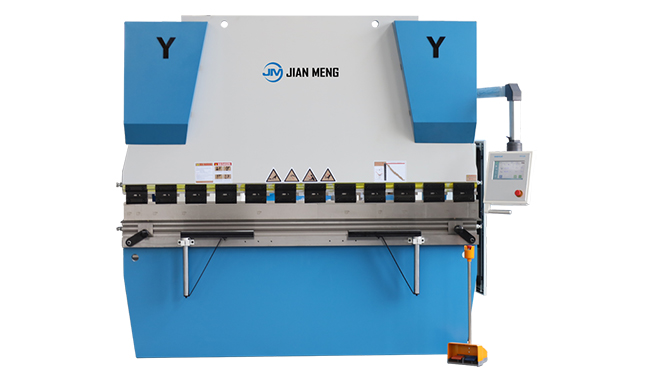
CNC press brakes, as a new type of high-precision sheet metal forming equipment, have gradually become the core equipment in sheet metal processing industry due to their high precision, high efficiency, high automation, and strong flexibility. The core advantage of CNC press brakes lies in the integration of numerical control technology and hydraulic control technology, which can realize precise control of the entire bending process, including the positioning of the sheet, the movement of the slider, the control of the bending angle, and the adjustment of the bending force. With the continuous upgrading of CNC technology, hydraulic technology, and intelligent control technology, CNC press brakes have realized functions such as automatic programming, online monitoring, and fault early warning, further improving the forming quality and production efficiency of sheet metal components.
At present, CNC press brakes have formed a variety of specifications and models, including hydraulic CNC press brakes, mechanical CNC press brakes, and electric servo CNC press brakes, which are suitable for different sheet metal materials, thicknesses, and forming requirements. For related practitioners, it is crucial to accurately understand the core technology, working principle, and technical characteristics of CNC press brakes. This paper comprehensively and systematically analyzes the core technology of CNC press brakes, focusing on the key technologies that ensure high-precision sheet metal forming, providing a comprehensive and professional technical guide for the selection, use, and technical research of CNC press brakes.
2. Core Technical System of CNC Press Brakes
The high-precision forming performance of CNC press brakes is supported by a complete core technical system, which mainly includes four parts: mechanical structure technology, numerical control system technology, hydraulic control system technology, and bending process technology. These technologies cooperate closely, forming a synergistic effect to ensure the precision, stability, and efficiency of sheet metal bending forming. The following is a detailed elaboration of each core technology.
2.1 Mechanical Structure Technology
The mechanical structure is the foundation of
CNC press brakes, directly determining the stability, rigidity, and forming precision of the equipment. The core mechanical components of CNC press brakes include the frame, slider, worktable, die (upper die and lower die), and guide mechanism. The rationality of the structural design and the precision of manufacturing directly affect the bending precision and service life of the equipment.
2.1.1 Frame Structure
The frame is the main load-bearing component of CNC press brakes, which bears the huge bending force during the bending process. To ensure high rigidity and anti-deformation ability, the frame is usually made of high-strength welded steel plate or cast steel, and undergoes strict stress relief treatment to eliminate internal stress generated during the welding or casting process. The frame structure is usually designed as a closed type, which can effectively disperse the bending force, reduce equipment vibration, and avoid deformation of the frame during the bending process, laying the foundation for high-precision forming. Some high-end CNC press brakes adopt a gantry-type frame structure, which further improves the rigidity and stability of the equipment, ensuring that the bending force is evenly distributed along the entire length of the slider.
2.1.2 Slider and Guide Mechanism
The slider is the core moving component of CNC press brakes, which drives the upper die to move up and down to complete the bending action. The slider is usually made of high-strength alloy steel, and undergoes quenching and tempering treatment to improve its strength and wear resistance. The guide mechanism is used to ensure the movement accuracy of the slider, usually composed of linear guides or guide rails, which can ensure that the slider moves vertically without deviation, and the movement accuracy is controlled within ±0.01mm. The guide mechanism is equipped with a lubrication system to reduce friction between the slider and the guide rail, ensuring smooth movement of the slider and extending the service life of the equipment.
2.1.3 Worktable and Die System
The worktable is used to place the sheet metal workpiece, and is usually equipped with a positioning device (such as a back gauge) to ensure the accurate positioning of the sheet. The worktable is made of high-precision cast iron or steel, and its upper surface is ground to ensure flatness and smoothness. The die system is the core component that directly contacts the sheet and completes the bending forming, including the upper die and the lower die. The upper die is fixed on the slider, and the lower die is fixed on the worktable. The die is made of high-speed steel or alloy tool steel, and undergoes precision grinding and heat treatment to ensure high hardness, wear resistance, and dimensional accuracy. The shape of the die can be designed according to the bending requirements of the workpiece, such as V-shaped die, U-shaped die, and special-shaped die, to realize the forming of different shapes of workpieces.
2.2 Numerical Control System Technology
The numerical control system is the ""brain"" of CNC press brakes, which is responsible for receiving and processing operation instructions, controlling the movement of the slider, the positioning of the back gauge, and the adjustment of bending parameters, and realizing the automatic control of the entire bending process. The performance of the CNC system directly determines the control precision, automation level, and operation flexibility of the CNC press brake.
2.2.1 Core Functions of CNC System
The CNC system of CNC press brakes has a variety of core functions, including: ① Automatic programming function: Operators can input the size and shape parameters of the workpiece into the CNC system, and the system can automatically generate the bending program, avoiding manual programming errors and improving programming efficiency. ② Parameter setting function: The system can set bending parameters such as bending angle, bending radius, bending force, and slider speed according to the material and thickness of the sheet, ensuring the accuracy of the bending process. ③ Back gauge positioning function: The back gauge is controlled by the CNC system to realize precise positioning of the sheet, ensuring the accuracy of the bending position. The back gauge can realize multi-axis movement (such as X-axis, Y-axis, Z-axis), which is suitable for the bending of complex-shaped workpieces. ④ Online monitoring function: The system can real-time monitor the operation status of the equipment, such as the position of the slider, the bending force, and the temperature of the hydraulic system, and issue an alarm in case of abnormal conditions, avoiding equipment damage and workpiece scrap. ⑤ Fault diagnosis function: The system can automatically diagnose common faults of the equipment and provide fault handling suggestions, reducing maintenance time and cost.
2.2.2 Key Technologies of CNC System
The key technologies of the CNC system for CNC press brakes include: ① High-precision position control technology: The system adopts closed-loop control technology, which can real-time detect the position of the slider and the back gauge through sensors, and adjust the movement of the slider and the back gauge in real time to ensure the positioning precision. The position control precision can reach ±0.005mm, ensuring the high-precision forming of the workpiece. ② Bending angle compensation technology: Due to the elastic deformation of the sheet and the equipment during the bending process, the actual bending angle may deviate from the set angle. The CNC system adopts bending angle compensation technology, which can automatically calculate the compensation value according to the material, thickness, and bending radius of the sheet, and adjust the movement of the slider to ensure that the actual bending angle meets the requirements. ③ Multi-axis linkage control technology: The system can realize the linkage control of multiple axes (such as slider axis, back gauge X-axis, Y-axis, Z-axis), which is suitable for the bending of complex-shaped workpieces, such as multi-angle bending and step bending.
2.3 Hydraulic Control System Technology
Most CNC press brakes adopt hydraulic transmission technology, and the hydraulic control system is responsible for providing power for the movement of the slider, controlling the bending force and slider speed, and ensuring the stability and smoothness of the bending process. The performance of the hydraulic control system directly affects the bending precision, efficiency, and stability of the equipment.
2.3.1 Core Components of Hydraulic Control System
The hydraulic control system of CNC press brakes is mainly composed of hydraulic pump, hydraulic cylinder, solenoid valve, proportional valve, relief valve, and oil tank. The hydraulic pump is the power source of the hydraulic system, which converts the mechanical energy of the motor into hydraulic energy. The hydraulic cylinder drives the slider to move up and down under the action of hydraulic oil. The solenoid valve and proportional valve are used to control the flow and pressure of hydraulic oil, realizing the control of the slider speed and bending force. The relief valve is used to adjust the maximum pressure of the hydraulic system, avoiding overpressure damage to the equipment. The oil tank is used to store hydraulic oil and cool the hydraulic oil to ensure the normal operation of the hydraulic system.
2.3.2 Key Technologies of Hydraulic Control System
The key technologies of the hydraulic control system include: ① Proportional pressure and flow control technology: The system adopts proportional valves to realize stepless adjustment of hydraulic pressure and flow, which can adjust the bending force and slider speed according to the material and thickness of the sheet, ensuring stable bending and improving forming quality. ② Hydraulic synchronization control technology: For large-format CNC press brakes, multiple hydraulic cylinders are usually used to drive the slider. The hydraulic synchronization control technology ensures that the multiple hydraulic cylinders move synchronously, avoiding the deviation of the slider and ensuring the uniform bending of the sheet. ③ Energy-saving control technology: The hydraulic system adopts variable frequency control technology and load-sensitive control technology, which can adjust the output power of the hydraulic pump according to the actual load, reducing energy consumption and achieving energy-saving and environmental protection.
2.4 Bending Process Technology
Bending process technology is the key to realizing high-precision sheet metal forming, which involves the selection of bending parameters, the design of the die, the positioning of the sheet, and the control of the bending sequence. The rationality of the bending process directly affects the forming precision, surface quality, and service life of the workpiece.
2.4.1 Selection of Bending Parameters
The key bending parameters include bending angle, bending radius, bending force, and slider speed. The selection of these parameters is based on the material, thickness, and forming requirements of the sheet. For example, for high-hardness materials (such as stainless steel), the bending force should be increased, and the slider speed should be reduced to avoid sheet cracking; for thin sheets, the bending radius should be appropriately increased to avoid sheet deformation. The CNC system can automatically select the optimal bending parameters according to the input sheet parameters, ensuring the forming quality.
2.4.2 Die Design and Selection
The die is the core component of the bending process, and its design and selection directly affect the forming precision and surface quality of the workpiece. The die should be designed according to the shape and size of the workpiece, and the material of the die should be selected according to the material and thickness of the sheet. For example, for bending high-hardness sheets, the die should be made of high-hardness alloy steel; for bending thin sheets, the die should be designed with a larger fillet to avoid sheet scratches. In addition, the gap between the upper die and the lower die should be adjusted according to the thickness of the sheet to ensure the smoothness of the bending edge and avoid edge burrs.
2.4.3 Sheet Positioning and Bending Sequence Control
The accurate positioning of the sheet is the premise of high-precision bending. The back gauge of the CNC press brake is used to realize the precise positioning of the sheet, and the positioning precision can reach ±0.01mm. For complex-shaped workpieces, the bending sequence is very important. The rational bending sequence can avoid mutual interference between the formed parts and the die, ensuring the forming precision of the workpiece. The CNC system can automatically determine the optimal bending sequence according to the shape of the workpiece, realizing automatic control of the bending process.
3. Key Technologies for High-Precision Sheet Metal Forming
The high-precision sheet metal forming of CNC press brakes is mainly guaranteed by four key technologies: high-precision positioning technology, bending angle compensation technology, hydraulic synchronization control technology, and intelligent process optimization technology. These technologies solve the key problems in the bending process, such as positioning deviation, angle deviation, slider asynchrony, and process irrationality, ensuring the high precision and high consistency of the formed workpiece.
3.1 High-Precision Positioning Technology
High-precision positioning technology includes slider position positioning and back gauge positioning. The slider position positioning is realized by the CNC system and the position sensor (such as linear encoder), which can real-time detect the position of the slider and adjust the movement of the slider in real time to ensure that the slider moves to the set position accurately. The back gauge positioning is realized by the multi-axis linkage control of the CNC system, which can realize the precise positioning of the sheet in the X-axis, Y-axis, and Z-axis directions, ensuring the accuracy of the bending position. The positioning precision of the slider and back gauge can reach ±0.005mm, which is the foundation of high-precision sheet metal forming.
3.2 Bending Angle Compensation Technology
During the bending process, due to the elastic deformation of the sheet and the equipment (such as the frame and slider), the actual bending angle of the workpiece will deviate from the set angle, which affects the forming precision. Bending angle compensation technology is used to solve this problem. The CNC system collects the relevant parameters (such as sheet material, thickness, bending radius, and bending force) through sensors, and uses the built-in mathematical model to calculate the elastic deformation amount of the sheet and the equipment, then automatically adjusts the movement of the slider to compensate for the angle deviation. The angle compensation precision can reach ±0.1°, ensuring that the actual bending angle of the workpiece meets the design requirements.
3.3 Hydraulic Synchronization Control Technology
For large-format CNC press brakes, the slider is usually driven by multiple hydraulic cylinders. If the movement of the hydraulic cylinders is not synchronized, the slider will tilt, leading to uneven bending of the sheet and affecting the forming precision. Hydraulic synchronization control technology uses proportional valves and synchronization sensors to real-time detect the movement speed and position of each hydraulic cylinder, and adjusts the flow of hydraulic oil to each hydraulic cylinder in real time to ensure that the multiple hydraulic cylinders move synchronously. The synchronization precision can reach ±0.01mm, ensuring the uniform bending of the sheet along the entire length.
3.4 Intelligent Process Optimization Technology
Intelligent process optimization technology integrates big data, artificial intelligence, and machine learning technology. The CNC system collects a large number of bending process data (such as sheet parameters, bending parameters, and forming quality data) during the operation process, and uses machine learning algorithms to analyze and optimize the bending process parameters. The system can automatically adjust the bending force, slider speed, and bending angle according to the actual situation, realizing the optimization of the bending process. This technology not only improves the forming precision and quality of the workpiece but also improves the production efficiency and reduces the scrap rate.
4. Technical Characteristics and Application Advantages of CNC Press Brakes
Compared with traditional bending equipment, CNC press brakes have unique technical characteristics and application advantages, which make them widely used in high-precision sheet metal forming fields. The specific technical characteristics and application advantages are as follows:
4.1 High Forming Precision and Good Consistency
CNC press brakes adopt high-precision positioning technology, bending angle compensation technology, and hydraulic synchronization control technology, which can ensure that the bending precision of the workpiece is within ±0.01mm, and the angle precision is within ±0.1°. At the same time, the CNC system realizes the automatic control of the bending process, avoiding the influence of human factors on the forming quality, ensuring the consistency of the batch workpieces. This advantage is particularly important in large-batch, high-precision sheet metal processing fields, such as automotive manufacturing and aerospace manufacturing.
4.2 High Automation and Intelligence Level
CNC press brakes are equipped with advanced CNC systems, which can realize automatic programming, automatic positioning, automatic bending, and automatic fault diagnosis. Operators only need to input the workpiece parameters into the system, and the system can automatically complete the entire bending process, reducing labor intensity and improving production efficiency. Some high-end CNC press brakes are also equipped with automatic loading and unloading devices, online measurement systems, and industrial Internet of Things (IoT) modules, which realize the intelligent management and remote monitoring of the equipment, further improving the automation level and production efficiency.
4.3 Strong Flexibility and Adaptability
CNC press brakes can adapt to the bending forming of various metal sheets, including carbon steel, stainless steel, aluminum alloy, copper alloy, and other materials, with a sheet thickness range of 0.1mm to 100mm (depending on the equipment specification). By replacing different dies and adjusting bending parameters, the equipment can realize the forming of different shapes of workpieces, such as V-shaped, U-shaped, Z-shaped, and special-shaped, with strong flexibility. This advantage makes CNC press brakes suitable for small-batch, multi-variety sheet metal processing fields, such as electrical and electronic manufacturing and hardware manufacturing.
4.4 High Production Efficiency and Low Scrap Rate
The automatic control and intelligent process optimization technology of CNC press brakes greatly shorten the programming time and bending time, improving production efficiency. Compared with traditional manual bending equipment, the production efficiency of CNC press brakes can be increased by 30%-50%. At the same time, the high-precision control of the bending process reduces the scrap rate of workpieces, which is usually controlled within 0.5%, reducing production costs.
4.5 Stable Operation and Long Service Life
The mechanical structure of CNC press brakes adopts high-strength materials and strict manufacturing processes, with high rigidity and anti-deformation ability. The hydraulic system and electrical system adopt modular design, which is convenient for maintenance and troubleshooting. The daily maintenance of the equipment is relatively simple, mainly including lubrication, cleaning, and die inspection and replacement. The service life of CNC press brakes can reach 10-15 years, which has good economic benefits.
5. Industrial Applications of CNC Press Brakes
Due to their excellent technical characteristics and application advantages, CNC press brakes are widely used in various industrial fields that require high-precision sheet metal forming. They play an important role in the production of metal components in machinery manufacturing, automotive, aerospace, electrical and electronic, and other industries. The following is a detailed analysis of the application scenarios of CNC press brakes in various industries:
5.1 Machinery Manufacturing Industry
The machinery manufacturing industry is the largest application field of CNC press brakes. In the production process of mechanical equipment, a large number of sheet metal components (such as housings, brackets, connecting plates, and covers) need to be bent and formed. CNC press brakes are used for the bending forming of these components, ensuring the precision and quality of the components, and laying the foundation for the assembly of mechanical equipment.
Specific Applications: Bending forming of sheet metal components for machine tools, pumps, valves, and other equipment; bending forming of structural parts for agricultural machinery, engineering machinery, and other equipment; bending forming of precision sheet metal components for electrical equipment (such as switch cabinets, distribution boxes, and control panels).
5.2 Automotive Manufacturing Industry
The automotive manufacturing industry has extremely strict requirements on the precision and consistency of sheet metal components. The body, chassis, door, hood, roof, and other components of automobiles are made of metal sheets, which need high-precision bending forming to ensure the assembly accuracy and safety of automobiles. CNC press brakes, with their high forming precision, good consistency, and high efficiency, are widely used in the bending forming of automotive sheet metal components.
Specific Applications: Bending forming of automotive body panels, chassis structural parts, door inner and outer panels, hood panels, roof panels, and other sheet metal components; bending forming of sheet metal components for automotive engines, gearboxes, and other components; bending forming of precision sheet metal components for new energy vehicle batteries, charging piles, and other components.
5.3 Aerospace Industry
The aerospace industry has ultra-high requirements on the precision, surface quality, and material performance of components. The sheet metal components used in aircraft, rockets, satellites, and other aerospace equipment are mostly made of high-strength alloy materials (such as titanium alloy, aluminum alloy), which require ultra-high-precision bending forming. CNC press brakes, with their high precision, high stability, and good adaptability to high-hardness materials, are essential equipment in the aerospace sheet metal forming field.
Specific Applications: Bending forming of sheet metal components for aircraft fuselage, wings, tail, and other components; bending forming of precision sheet metal components for aerospace engines, avionics equipment, and navigation systems; bending forming of sheet metal components for satellite housings, solar panels, and other components.
5.4 Electrical and Electronic Industry
The electrical and electronic industry requires a large number of precision sheet metal components, such as shells of electrical appliances, heat sinks, connectors, and brackets. These components have small sizes, high precision requirements, and complex shapes, which need high-precision bending forming equipment. CNC press brakes, with their high forming precision, strong flexibility, and high automation, are widely used in the bending forming of precision sheet metal components in the electrical and electronic industry.
Specific Applications: Bending forming of sheet metal shells for household appliances (such as refrigerators, air conditioners, washing machines, and televisions); bending forming of precision sheet metal components for electronic equipment (such as computers, mobile phones, servers, and routers); bending forming of heat sinks, connectors, and brackets for electrical components.
5.5 Other Application Fields
In addition to the above fields, CNC press brakes are also used in other industries that require high-precision sheet metal forming, such as:
- Hardware Manufacturing Industry: Bending forming of sheet metal parts for hardware products (such as locks, hinges, brackets, and handles).
- Construction Industry: Bending forming of metal sheets for building decoration (such as curtain walls, ceilings, handrails, and signboards); bending forming of steel plates for building steel structures.
- Container Manufacturing Industry: Bending forming of steel plates for containers, tank bodies, and other components.
6. Common Problems and Solutions in the Use of CNC Press Brakes
In the process of using CNC press brakes, due to factors such as improper operation, parameter setting, die wear, and equipment aging, some common problems may occur, which affect the forming quality and production efficiency. The following are common problems and corresponding solutions:
6.1 Problem 1: Bending Angle Deviation
Causes: Improper bending angle compensation, incorrect parameter setting, die wear, or elastic deformation of the sheet.
Solutions: Re-calibrate the bending angle compensation parameters of the CNC system; adjust the bending parameters (such as bending force, slider speed) according to the sheet material and thickness; dress or replace the worn die; select the appropriate bending radius to reduce the elastic deformation of the sheet.
6.2 Problem 2: Bending Edge with Burrs or Scratches
Causes: Improper die gap adjustment, worn die surface, uneven sheet surface, or insufficient lubrication between the die and the sheet.
Solutions: Adjust the die gap according to the sheet thickness; dress or replace the worn die; clean the sheet surface to remove impurities; apply lubricating oil between the die and the sheet to reduce friction.
6.3 Problem 3: Slider Asynchrony
Causes: Malfunction of the hydraulic synchronization control system, worn hydraulic cylinder, or uneven hydraulic pressure.
Solutions: Check the hydraulic synchronization control system and adjust the proportional valve and synchronization sensor; inspect and repair the worn hydraulic cylinder; check the hydraulic pressure and adjust the relief valve to ensure uniform hydraulic pressure.
6.4 Problem 4: Back Gauge Positioning Deviation
Causes: Malfunction of the back gauge sensor, loose back gauge mechanism, or incorrect programming.
Solutions: Calibrate the back gauge sensor; check and tighten the back gauge mechanism; recheck the programming parameters and correct the positioning error.
6.5 Problem 5: Hydraulic System Failure
Causes: Hydraulic oil leakage, blocked oil circuit, damaged solenoid valve, or insufficient hydraulic oil.
Solutions: Check the hydraulic oil pipeline and joints to repair leaks; clean the oil circuit and filter to remove blockages; replace the damaged solenoid valve; add hydraulic oil to the specified level and replace the hydraulic oil regularly.
7. Development Trends of CNC Press Brake Technology
With the continuous advancement of intelligent manufacturing, precision processing, and green manufacturing technology, CNC press brake technology is developing in the direction of ultra-high precision, intelligence, high efficiency, greenization, and integration. The main development trends are as follows:
- Ultra-High Precision Development: With the increasing demand for ultra-high-precision sheet metal forming in aerospace, semiconductor, and other fields, CNC press brakes are developing towards ultra-high precision. The positioning precision of the slider and back gauge will be further improved to ±0.001mm, and the angle precision will be controlled within ±0.05°, meeting the ultra-high precision requirements of complex components. At the same time, the mechanical structure and hydraulic control system will be further optimized to reduce the influence of elastic deformation on forming precision.
- Intelligent Development: The integration of artificial intelligence (AI), Internet of Things (IoT), and big data technology into CNC press brakes will realize more intelligent functions, such as automatic fault prediction, adaptive process adjustment, and remote operation and maintenance. The equipment can automatically identify the sheet material and thickness, and adjust the bending parameters in real time to achieve optimal forming effect. The integration of robot technology will realize the full automation of the sheet metal processing line, including automatic loading, automatic bending, and automatic unloading, further improving production efficiency.
- High Efficiency Development: By optimizing the structural design, improving the slider speed, and integrating multi-station processing technology, the production efficiency of CNC press brakes will be further improved. The development of high-speed hydraulic technology and electric servo technology will greatly improve the movement speed of the slider, reducing the bending cycle. In addition, the development of integrated processing technology will realize the integration of bending, cutting, and stamping, further improving production efficiency and reducing production costs.
- Green Development: By optimizing the hydraulic system, using environmentally friendly hydraulic oil, and improving the energy efficiency of the equipment, the environmental impact of CNC press brakes will be reduced. The development of electric servo CNC press brakes will replace traditional hydraulic press brakes, reducing energy consumption and oil pollution. At the same time, the recyclability of the equipment and dies will be improved, reducing resource waste.
- Integration Development: CNC press brakes will be integrated with other sheet metal processing equipment (such as CNC shears, CNC punches) to form a flexible sheet metal processing line. The integration of the production line will realize the seamless connection of various processing links, improving the production efficiency and processing quality of sheet metal components. In addition, the integration of digital twin technology will realize the virtual simulation and optimization of the bending process, reducing the trial production time and cost.





 English
  中文
中文  Arabic
  Russian
  Spanish
  Portuguese
  French
  German
  Hindi
Hindi  Thai
Thai  Vietnamese
  Khmer
Khmer  Italian
  Turkish
  Korean
  Belarusian