CNC Electro Hydraulic Synchronous Press Brake: Reading The Spec Sheet Properly
Release time:2026-11-06
Visits:0
Most buyers open a quotation with one question: how many tonnes and how long is the bed. Those two numbers get negotiated for a week while throat depth, open height, ram speed and compensation method are left to the supplier's discretion. Six months later the machine cannot bend the box section that started the whole project, and nobody remembers why.
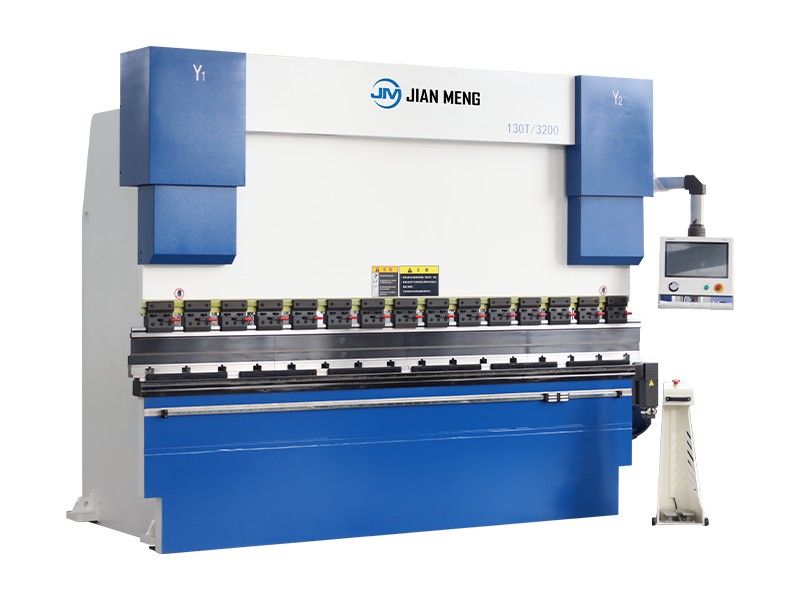
CNC Electro Hydraulic Synchronous Press Brake
Why "Synchronous" Is the Whole Point
A press brake bends sheet by pushing a ram down between two hydraulic cylinders. If the two sides of the ram travel at slightly different rates, the punch enters the die at an angle, and the bend line is no longer parallel to the backgauge. On a 3,200 mm bed, a 0.1 mm difference in ram height between left and right is enough to change the included angle across the part.
What Y1 and Y2 actually control
Y1 is the left cylinder position, Y2 the right. On a genuinely synchronous machine each cylinder carries a linear encoder or a pressure-and-position feedback loop, and the CNC compares the two values several hundred times per second, correcting the servo valve on whichever side is lagging. The ram stays level under eccentric load, which is exactly what happens when a narrow blank is bent at one end of a long bed.
Where cheaper machines drift
Machines that only look at total ram position, or that rely on a proportional valve without closed-loop position feedback, will hold angle in the middle of the bed and lose it at the ends. The drift is not constant: it changes with oil temperature, with load distribution, and with the age of the valve. That is why two machines with identical tonnage can behave completely differently on the same job.
Jianmeng builds the WE67K series around this principle. The two cylinders sit close together with an electro-hydraulic servo and synchronous control design, giving strong resistance to eccentric load, and the hydraulic circuit includes a filtration stage to keep oil clean and cut the failure rate over the machine's life.
The Five Numbers That Decide the Machine
Tonnage and bend length are the headline figures, but three more decide whether a part can be made at all.
|
Spec |
What it controls |
Where buyers get caught |
|
Bending force (kN) |
Maximum tonnage per metre of bend |
Buying for the thickest part ever quoted, then running at 20% load |
|
Bend length (mm) |
Longest blank the bed accepts |
Confusing bend length with column spacing |
|
Column spacing (mm) |
Clear width between housings |
Long shallow pans that fit the bed but not between columns |
|
Throat depth (mm) |
How deep a box or return flange can be |
Box sections deeper than the throat cannot be bent at all |
|
Open height (mm) |
Room for punch, die and part stack |
Tall dies or a part that must pass over the punch |
Tonnage is not a free upgrade
A useful shop-floor approximation for mild steel is 650 × t² / V kilonewtons per metre, where t is thickness in millimetres and V is the V-die opening. For 3 mm sheet in a 24 mm die that gives roughly 244 kN/m, so a 3,200 mm bed needs about 780 kN if the full length is loaded — which is why a 1,100 kN machine covers most 3 mm work with margin. Stainless steel needs roughly 1.5 times the force, and aluminium slightly less. Buying 400 tonnes to bend 4 mm cabinets costs money in motor size, oil volume, floor loading and freight, and it does not improve accuracy.
Throat depth decides whether the part fits
The WE67K range runs from a 250 mm throat on the small 500 kN frames to 600 mm on the 6,000–8,000 kN models. If your product family includes deep electrical enclosures or elevator door returns, check the throat before the tonnage. A machine with 100 tonnes of headroom and 100 mm too little throat is useless.
Crowning: the Second Half of Angle Accuracy
Synchronisation keeps the ram level. It does not stop the ram and the bed from deflecting in the middle under load. Every
press brake bends its own structure a little, and the middle of a full-length bend receives less effective force than the ends.
How compensation is generated
Mechanical crowning uses a wedge table driven by the CNC. Hydraulic crowning uses a row of small cylinders under the bed. Both work; the difference is repeatability and how the value is calculated. Jianmeng's system computes the compensation value from the combined deformation of the ram and the worktable, matching the bed's deflection curve to the compensation curve rather than applying a table of nominal values. On a 4,000 mm bed running 3 mm stainless, that is the difference between ±0.5° and ±0.2° across the part.
Checking it in the workshop
Bend a full-width test strip at three positions — left, centre, right — and measure all three angles. Then bend a narrow strip at the extreme left and the extreme right. If the centre is open but the ends are correct, crowning is under-compensated. If the ends are open, it is over-compensated. If left and right differ, the problem is synchronisation, not crowning. Two tests separate the two systems, and both take ten minutes.
Controls, Hydraulics and the Details That Age
Controller choice is a support decision
|
Controller |
Origin |
Typical reason to choose it |
|
Delem |
Netherlands |
Widest operator familiarity, strong 2D/3D programming |
|
Cybelec |
Switzerland |
Common in European job shops, good bend databases |
|
ESA |
Italy |
Simple interface, popular with mixed-skill teams |
|
Laimore |
China |
Cost-efficient, adequate for repetitive work |
The controller determines how quickly a new operator becomes productive and how easily you can find someone to service it in ten years. A shop with three Delem machines should not buy its fourth brake with a different platform to save a few percent.
Oil temperature is a precision issue
Hydraulic oil that heats up changes viscosity, and viscosity changes the response of every valve in the circuit. Machines that run two shifts without a heat exchanger will show angle drift through the afternoon. A filtration system and a properly sized tank do more for long-run consistency than an extra CNC axis.
Acceptance: What to Measure on Day One
Do not accept a machine on a demonstration part chosen by the supplier. Bring three of your own:
• A full-length part in your thinnest and thickest gauge, to expose both deflection and tonnage limits.
• A deep box section, to prove throat depth and open height in practice.
• A short part bent at each end of the bed, to test synchronisation under eccentric load.
Record the angles, the straightness, and the ram position repeatability for twenty consecutive cycles. That data is your baseline; when the machine drifts in year three, you will know what it used to do.
Working With Jianmeng
Jianmeng Intelligent Equipment (Taizhou) Co., Ltd. has spent over 30 years building sheet metal machinery in Jiangsu, with more than 50 patents, an 8,500 m² plant and roughly 300 machines a year going to a customer base that now exceeds 3,500 companies. The WE67K platform covers 500 kN to 8,000 kN with bed lengths from 1,300 mm to 8,000 mm, four-plus-one to eight-plus-one axes, and a choice of Delem, Cybelec, ESA or Laimore control.
The practical value of that breadth is that the specification conversation starts from your part rather than from a catalogue. Send a drawing with the thickest gauge, the longest blank and the deepest return flange, and the frame, throat and crowning can be matched to it instead of guessed at.




 English
 中文
 Arabic
 Russian
 Spanish
 Portuguese
 French
 German
 Hindi
 Thai
 Vietnamese
 Khmer
 Italian
 Turkish
 Korean
 Belarusian