Laser Grooving Machine: When A Laser Makes Sense For Grooving
Release time:2026-10-19
Visits:0
Two ways to cut a groove
A mechanical grooving machine uses a spinning cutter to remove material pass by pass. A laser grooving machine uses a focused laser beam to do the same job. Same result on the part — a precise V-groove along the bend line so the sheet folds into a sharp right angle — but a completely different process underneath.
The laser vaporises and melts material along a programmed path, without physical contact and without a tool bit that wears. That difference opens up options that mechanical cutting cannot easily offer, and it also brings its own constraints. Understanding both is how you decide whether a laser grooving machine belongs in your shop.
How laser grooving works
The laser head moves over the sheet on a CNC-controlled gantry, following the groove path. The beam cuts to a controlled depth by adjusting power and travel speed. Because there is no tool to blunt, the process stays consistent across long runs, and the beam can reach places and follow paths that a physical cutter would struggle with.
In practice, lasers appear in sheet metal grooving in two forms. One is a pure laser groove cutting station. The other — and increasingly the more common — is a laser composite machine that combines grooving with laser cutting and shearing in a single setup, so a part can be cut to shape, grooved and sheared without moving between machines.
What a laser grooving machine delivers
Contactless cutting. No tool wear, no tooling changes for different groove profiles. Less downtime between jobs.
Speed and flexibility. Laser cutting heads travel quickly, and the controller switches between cutting and grooving operations in the same program.
Multi-function efficiency. When grooving is combined with cutting in one machine, the material is handled once instead of three times. A vertical laser composite machine can combine laser cutting, shearing and V-grooving, saving up to 50% of workshop space compared with separate machines.
Precision. Laser positions with high accuracy, and the machine holds table flatness tightly, which keeps groove depth consistent.
Where the laser is at its best
The
laser grooving machine shines for shops that already work with lasers, run long, repetitive panel jobs, and want to compress several operations into one machine. Because the laser also cuts, a composite machine replaces multiple standalone units in the workshop — a big win on both space and the time spent shuttling sheets between workstations.
For very thick or very large plate, mechanical grooving still holds its ground, and the laser's role there is smaller. But for stainless steel cabinets, aluminium curtain walls and architectural panels in the 0.4 to 6.0 mm range, the laser composite route is becoming the mainstream choice.
What to check before you buy
- Laser power. Common grooving-class lasers run 1.5 to 3.0 kW. More power cuts thicker material faster.
- Plate thickness range. Confirm the machine handles your thickest and thinnest sheet — around 0.4 to 6.0 mm is typical.
- Combined functions. Does it groove, cut and shear in one setup? That is where the space and time savings come from.
- Positioning accuracy and table flatness. These set how consistent the groove and cut are.
- Component quality. Check the laser source, cutting head, controller and linear guides — names like MAX fiber sources, WSX heads and heavy linear guides signal build quality.
Jianmeng's laser grooving machines
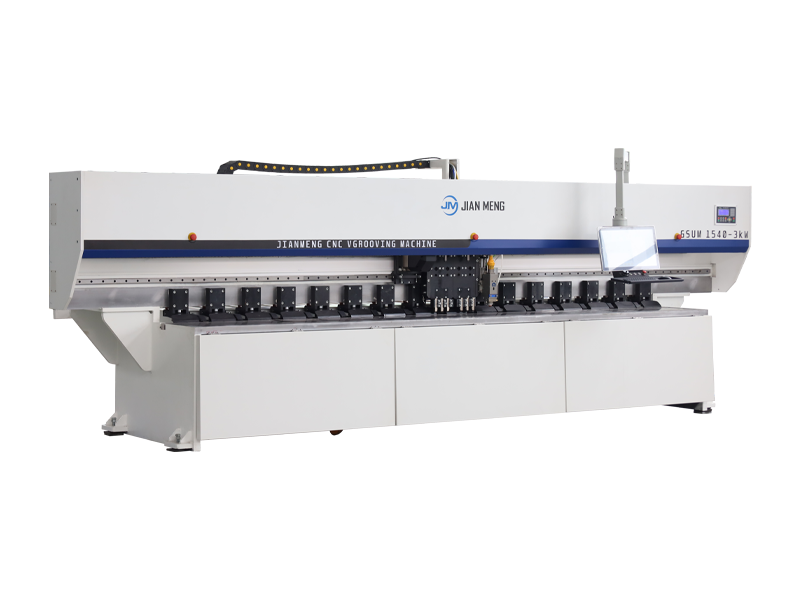
Jianmeng builds both groove-cutting stations and laser composite machines that integrate V-grooving, shearing and laser cutting. Our vertical laser composite machine processes stainless steel and aluminium at grooving speeds up to 120 m/min with ±0.02 mm repeatability, powered by 1.5 to 3.0 kW fiber lasers and built with components from suppliers such as MAX, WSX and Schneider. Thirty years of machine building and more than 3,500 customers worldwide back the design — tell us your material and part sizes, and we will match the machine to the job.
Frequently asked questions
Is a laser grooving machine better than a mechanical one?
It depends on the work. The laser is contactless, flexible and multi-functional, and shines when combined with cutting. Mechanical grooving remains the right tool for very thick and very large plate.
What thickness can a laser grooving machine handle?
Typically 0.4 to 6.0 mm for machines in this class, depending on laser power.
Can one machine groove and cut?
Yes. Composite laser machines combine V-grooving, shearing and laser cutting in a single setup, saving workshop space and reducing handling.
Why combine grooving with laser cutting?
Because the part often needs both, and doing them on one machine means one loading instead of moving material between several machines — a significant saving in space and time.




 English
  中文
中文  Arabic
  Russian
  Spanish
  Portuguese
  French
  German
  Hindi
Hindi  Thai
Thai  Vietnamese
  Khmer
Khmer  Italian
  Turkish
  Korean
  Belarusian