Laser Composite Grooving Machine: Cut And Groove Without The Moving Around
Release time:2026-10-16
Visits:0
Why combine a laser with a groover?
Most sheet metal parts do not just need grooving. They need to be cut to shape, have straight edges sheared, and be grooved along the bend lines so they fold into clean right angles. On a conventional line those are three machines and three separate handlings of the sheet.
The laser composite
grooving machine removes the moving around. Laser cutting, shearing and V-grooving all happen on one machine, with the sheet loaded once. The part goes in as a flat blank and comes out cut, sheared and grooved, ready for the press brake. That compression of the workflow is the entire reason the machine exists.
How the processes work together
- Laser cutting. A fiber laser cuts the sheet to the finished outline, handling shapes that a shear cannot.
- Shearing. Straight edges are sheared cleanly, covering the simple cuts quickly.
- V-grooving. V-grooves are cut along the bend lines, so the sheet bends into sharp, accurate right angles with less force and less springback.
All three are controlled from one program, and the same sheet can move between operations without being taken off the machine. Drawings can be imported and the machine programmed in one click, which removes most of the manual setup time.
The case in numbers
|
Benefit |
What it means |
|
Floor space |
Up to 50% saved versus three separate machines |
|
Material handling |
Sheet loaded once instead of three times |
|
Productivity |
Multiple functions in one setup, fewer queues |
|
Precision |
±0.02 mm repeatability, 0.03 mm table flatness |
|
Speed |
Grooving up to 120 m/min |
The combination of fewer handlings and no queuing at separate stations is where the machine pays back. It suits shops that run stainless steel cabinets, aluminium curtain walls and architectural panels in volume.
Specification and build quality
Match the machine to your work on the details:
- Plate thickness — around 0.4 to 6.0 mm in stainless for machines in this class.
- Laser power — 1.5 to 3.0 kW for grooving-class lasers.
- Edge distances — minimum groove distance from edge around 8 mm, minimum laser cut distance around 25 mm.
- Components — named suppliers such as MAX fiber sources, WSX cutting heads, EASYCAT controllers and TBI guides signal build quality.
Jianmeng's laser composite machine
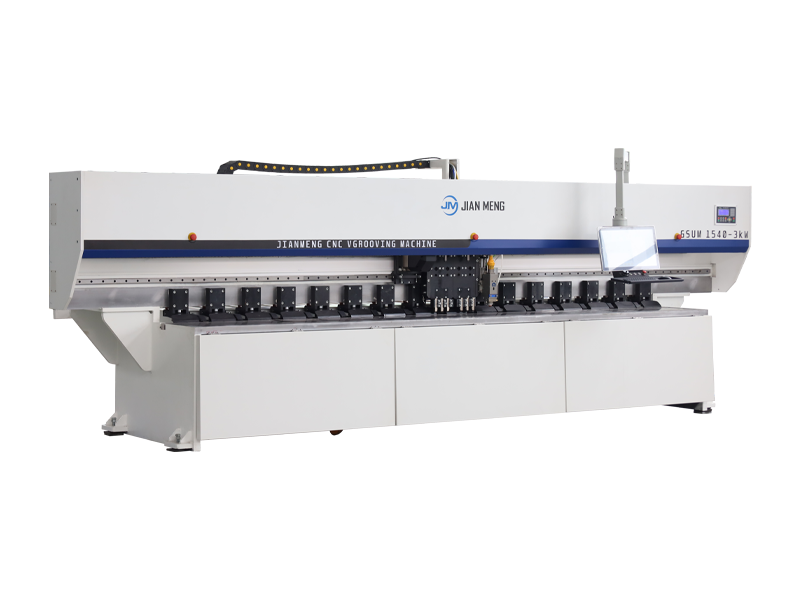
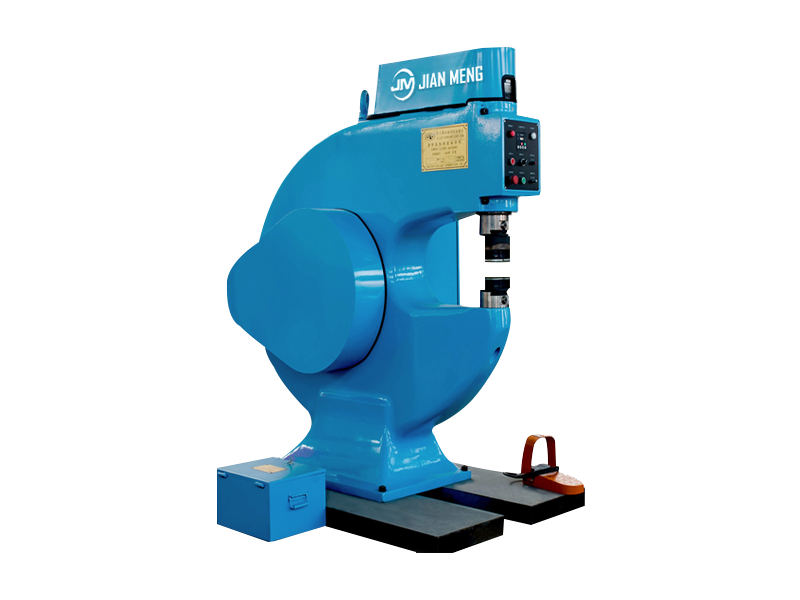
Jianmeng's laser composite machine integrates V-grooving, shearing and laser cutting in one vertical, compact unit. It processes stainless steel and aluminium at grooving speeds up to 120 m/min with ±0.02 mm repeatability, using 1.5 to 3.0 kW fiber lasers and components from MAX, WSX, TBI and Schneider. Jianmeng introduced its first gantry CNC grooving machine in 2008 and pioneered automatic four-side V-grooving in 2015 — 30 years of development, 50+ patents and more than 3,500 customers worldwide underpin the design. We size the machine against your parts, not a brochure.
Frequently asked questions
What is a laser composite grooving machine?
A machine that combines laser cutting, shearing and V-grooving in one unit, so a sheet is processed through all operations in a single loading.
Why is it called "composite"?
Because it composites, or combines, multiple sheet metal processes into one machine rather than requiring separate machines.
How much space does it save?
Shops typically report up to 50% floor-space savings compared with running separate cutting, shearing and grooving machines.
What is it best for?
Repeat work on stainless steel and aluminium panels in the 0.4 to 6.0 mm range, where compressing three operations into one loading cuts handling time and workshop space.




 English
  中文
中文  Arabic
  Russian
  Spanish
  Portuguese
  French
  German
  Hindi
Hindi  Thai
Thai  Vietnamese
  Khmer
Khmer  Italian
  Turkish
  Korean
  Belarusian