Sheet Metal V-Grooving Machine: The Route To Sharp, Seamless Corners
Release time:2026-10-26
Visits:1
The machine that makes the corner sharp
Look closely at the corner of a well-made stainless steel cabinet or a curtain wall panel. The outside corner is sharp, clean, almost seamless — no weld bead, no grinding marks. That corner did not happen by bending flat sheet. It happened because a sheet metal V-grooving machine cut a groove along the bend line first.
The principle is simple: remove a wedge of material where the sheet is going to fold, and the bend becomes clean and effortless. Fold stainless without that groove and the corner rounds off; on harder alloys it can crack. The
V-grooving machine turns flat sheet metal into a part with sharp, accurate right angles, which is the look the market expects from high-end metal products.
What a sheet metal V-grooving machine processes
The machine is built for the sheet metals that dominate architectural and cabinet work:
- Stainless steel — the classic application, from kitchen-grade to architectural finishes.
- Aluminium alloy — curtain walls, decorative panels and light structures.
- Mild steel — general fabrication where clean corners matter.
- Other sheet metals within the machine's thickness range.
The typical thickness envelope is roughly 0.4 to 5.0 mm, which covers the overwhelming majority of panel and enclosure work.
How it works, pass by pass
Grooving is not a single plunge. The cutter makes a series of passes along the groove line, each one a little deeper, until it reaches the programmed depth. The controller manages the increments and the speed, leaving a controlled remaining thickness at the bottom of the groove.
That remaining thickness is the real product of the machine. Cut too deep and the sheet splits at the bend. Cut too shallow and the corner stays rounded. Precision here — around ±0.02 mm repeatability and ±0.03 mm table flatness — is what separates a machine that makes clean corners from one that makes scrap.
Where it pays off
|
Application |
Why grooving matters |
|
Stainless steel cabinets |
Sharp, seamless outside corners |
|
Aluminium curtain walls |
Clean angles on long panels |
|
Elevator panels and doors |
Flat, precise finish |
|
High-end metal doors |
Decorative edges, tight right angles |
|
Architectural sheet metal |
Appearance is the product |
Beyond appearance, grooving takes load off the press brake. Less bending force, less springback, better tolerance. Parts come off requiring far less grinding, polishing and welding cleanup, which is money saved after the machine is paid for.
Choosing a machine for your sheet metal
Buy around your parts, not the brochure.
- Table size and processing range. Match the machine to your largest sheet — from 1250×3200 mm up to 1500×6000 mm.
- Plate thickness. Confirm the range covers your thickest and thinnest material.
- Speed. Grooving speeds up to 120 m/min drive your throughput.
- Accuracy. Repeatability ±0.02 mm and flatness ±0.03 mm set the corner quality.
- Orientation. Horizontal machines use a large flat table; vertical machines save floor space and ease large-sheet handling.
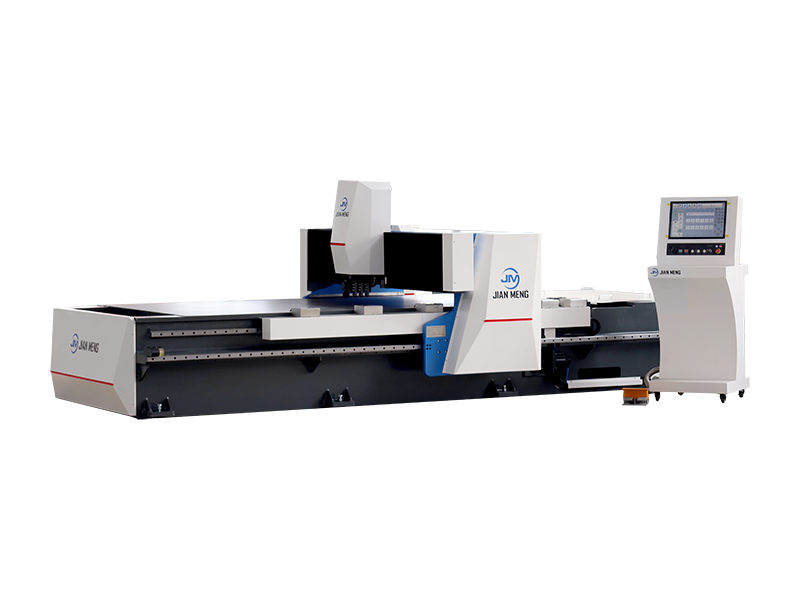
- Multi-function options. Some machines combine grooving with laser cutting or shearing to compress several processes into one setup.
Jianmeng and sheet metal grooving
Grooving is not a side line for Jianmeng — it is where the company built its reputation. Jianmeng introduced its first gantry-style CNC V-grooving machine in 2008 and pioneered automatic four-side V-grooving in 2015. Today the range spans horizontal, vertical, reciprocating vertical and laser composite machines, used in high-end metal doors, stainless steel cabinets, aluminium curtain walls and elevator manufacturing. With 50+ patents, 30 years of development and more than 3,500 customers worldwide, we will size a machine to your sheet sizes and tolerances.
Frequently asked questions
What thickness of sheet metal can it groove?
Typically 0.4 to 5.0 mm for machines in this class, which covers most cabinet, curtain wall and architectural work. Confirm against your thickest material.
Does V-grooving weaken the sheet?
It removes material at the bend line deliberately, to allow a sharp bend. The remaining thickness is controlled by the groove depth setting, so strength is managed by design.
Can it handle both stainless and aluminium?
Yes. Stainless steel and aluminium alloy are the two most common materials processed by these machines.
Why groove instead of just bending?
Without a groove the outside corner rounds off and may crack on harder materials. Grooving produces sharp, seamless right angles with less bending force and less springback.




 English
  中文
中文  Arabic
  Russian
  Spanish
  Portuguese
  French
  German
  Hindi
Hindi  Thai
Thai  Vietnamese
  Khmer
Khmer  Italian
  Turkish
  Korean
  Belarusian