ECO Dual Servo Hybrid Press Brake: Where The Money Comes Back
Release time:2026-11-09
Visits:0
A press brake spends most of its life not bending. It sits with the ram up while the operator positions a blank, checks a dimension, swaps a part, walks to the next station. On a conventional hydraulic machine the pump keeps turning through all of it, holding pressure against a relief valve and turning electrical energy into oil temperature.
The
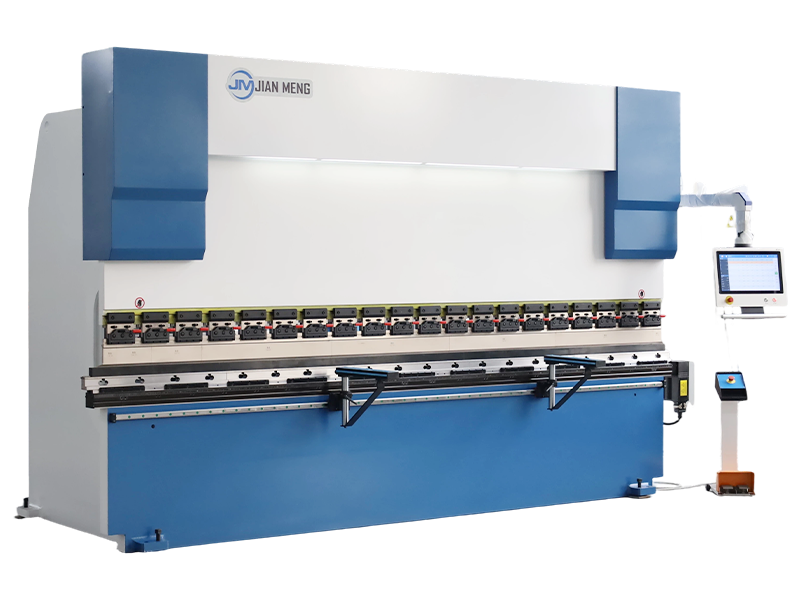
ECO dual servo hybrid press brake exists to remove that waste. Whether it is worth the premium depends on how much of your day is spent in that idle state — and on a few numbers that are easy to measure before you buy.
What the Dual Servo Arrangement Actually Does
Two motors, two pumps, two sides
A dual servo hybrid replaces the single main motor and proportional valve group with a left and a right servo motor, each driving its own pump. Those two units control the fast approach, the bending stroke and the return of Y1 and Y2 directly. Position is commanded by motor rotation rather than throttled by a valve, so the response is measured in milliseconds instead of the tens of milliseconds a proportional valve needs to react.
That is the mechanical reason a hybrid machine's cycle is shorter. Jianmeng's hybrid platform is quoted at roughly 30% faster bending cycles than a synchronous hydraulic machine of similar size, because the servo does not have to wait for pressure to build in a valve body before the ram moves.
Standby becomes silent
When the machine is not bending, the servo motors stop. Not idling against a relief valve — stopped. The result is a machine that is genuinely quiet between parts, which matters more than it sounds in a shop where two brakes run eight hours beside an operator who has to hear instructions.
Oil lasts longer because it stays cool
Heat is what kills hydraulic oil. In a hybrid circuit, the pump only works when the ram moves, so far less energy is dumped into the tank. The hybrid consumes about one third of the oil volume of an electro-hydraulic synchronous model, oil temperature stays controllable with no obvious rise during the shift, and in normal service the oil does not need replacing for around three years.
Reading the Model Range
The DHPB range in Jianmeng's catalogue runs from 800 kN on a 2,500 mm bed to 3,200 kN on a 6,100 mm bed. A representative slice of the table shows how stroke, open height and speed scale:
|
Model |
Force (kN) |
Bend length (mm) |
Stroke (mm) |
Open height (mm) |
Approach speed (mm/s) |
|
DHPB-80/2500 |
800 |
2,500 |
160 |
425 |
300 |
|
DHPB-110/3200 |
1,100 |
3,200 |
225 |
500 |
300 |
|
DHPB-170/4100 |
1,700 |
4,100 |
225 |
500 |
300 |
|
DHPB-250/4100 |
2,500 |
4,100 |
250 |
525 |
150 |
|
DHPB-320/6100 |
3,200 |
6,100 |
300 |
575 |
100 |
Two things stand out. First, approach speed falls as tonnage rises, from 300 mm/s on the small frames to 100 mm/s on the 3,200 kN model — the mass of the ram and the size of the pumps set a physical limit. Second, open height grows only slowly, from 425 mm to 575 mm, which is why tall tooling packages need to be checked early rather than assumed.
Where the hybrid range stops
Above roughly 3,200 kN the economics shift. Very large forces need very large servo pumps, and the price gap against a conventional electro-hydraulic machine widens faster than the energy saving grows. Jianmeng's wider press brake range covers 63 to 3,000 tonnes across platforms, with the hybrid concept concentrated in the small and mid range where the duty cycle is dominated by idle time and short strokes.
The Cost Comparison That Matters
Comparing purchase price alone will always favour the simplest machine. Comparing cost per bent part tells a different story.
|
Cost element |
Conventional hydraulic |
Electro-hydraulic synchronous |
Dual servo hybrid |
|
Idle power draw |
Continuous, significant |
Continuous but lower |
Near zero when stopped |
|
Oil volume and changes |
Large tank, frequent changes |
Standard |
About one third the volume, long interval |
|
Cycle time on short strokes |
Baseline |
Baseline |
Roughly 30% faster |
|
Noise in standby |
Pump and valve noise |
Pump noise |
Silent |
|
Heat rejected into the shop |
High |
Moderate |
Low |
|
Service complexity |
Mature, simple |
Mature, valve-based |
Servo drives need trained technicians |
The three-part test
A hybrid pays back when at least two of these are true:
• Short strokes, high part count. Small boxes, brackets and clamps with a 30 mm stroke waste most of a conventional machine's cycle in valve response.
• High idle fraction. One operator running one machine with manual handling means the brake is idle 50–70% of the time.
• Air-conditioned or sealed shop. Rejected hydraulic heat becomes a cooling load; removing it can be worth more than the electricity saved.
It pays back slowly when the machine runs long strokes in thick plate all day, when the shop is unheated, or when the nearest servo-qualified technician is a flight away.
Configuration Choices That Change the Answer
Controller and axis count
The hybrid platform is normally supplied with Delem, Cybelec, ESA or the ECO control, at four-plus-one, six-plus-one or eight-plus-one axes. Every additional axis adds a servo drive and a set of parameters to commission. A shop bending one product family in three gauges rarely needs more than four-plus-one plus crowning; a job shop with a new drawing every day gets real value from the extra axes because setup time, not cycle time, dominates.
The options worth taking
• Bending angle measurement. A laser or contact angle sensor closes the loop on the finished angle rather than the ram position, which is the only way to hold ±0.5° on stainless with varying springback.
• Fast clamping. Front-loading quick clamps turn a 20-minute tooling change into five, and on a hybrid machine the tooling change is often the longest part of the setup.
• Bending follower supports. For thin, wide panels, a support that follows the ram prevents the part from bowing under its own weight and changing the measured angle.
Commissioning a Hybrid Machine
The first week decides whether the machine delivers its quoted numbers. Three checks are worth insisting on:
1. Measure standby consumption with a clamp meter. With the machine powered and idle, current draw should be close to control-only. If it is not, a parameter is holding the servos energised.
2. Log oil temperature across a full shift. A hybrid should stay flat. A rise of more than a few degrees points to a cooling or circulation problem that will show up later as drift.
3. Time twenty cycles, not one. Servo response advantages appear in the average, not in a single demonstration stroke.
Working With Jianmeng
ECO Dual servo hybrid press brake
Jianmeng Intelligent Equipment (Taizhou) Co., Ltd. has been building sheet metal machinery for more than 30 years, holds over 50 patents, and ships around 300 machines a year from an 8,500 m² plant to a customer base of 3,500-plus companies across Southeast Asia, the Middle East, Europe and the Americas. The
ECO dual servo hybrid platform sits alongside its electro-hydraulic, torsion bar, mini servo electric, tandem and robotic cell ranges, which means a hybrid can be specified against the same tooling and controller standards as the rest of a shop's brakes.
For a buyer, the useful question is not whether hybrid technology is better. It is which of your parts spend the most time between strokes, and what that idle time costs per year. Answer that, and the model selection follows.




 English
 中文
 Arabic
 Russian
 Spanish
 Portuguese
 French
 German
 Hindi
 Thai
 Vietnamese
 Khmer
 Italian
 Turkish
 Korean
 Belarusian