Torsion Bar Synchronous NC Press Brake: Mechanical Sync Explained
Release time:2026-11-13
Visits:1
There is a persistent assumption in sheet metal that anything with a torsion bar is old technology and anything with two encoders is modern. Like most assumptions in machine tools, it is half right. A torsion bar machine and an electro-hydraulic machine solve the same problem — keeping both ends of the ram at the same height — with different mechanisms, and each mechanism has a range of work where it is the better answer.
The Mechanism
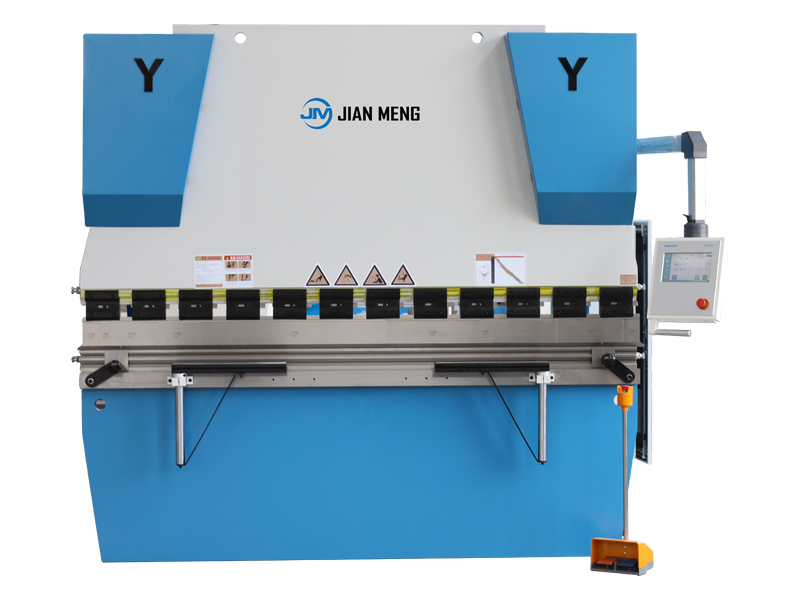
Torsion bar Synchronous NC Press Brake
A
torsion bar press brake connects the two ends of the ram to a heavy steel tube running across the top of the frame. When one cylinder tries to descend faster than the other, the tube resists the difference in rotation. The bar twists a small, calculable amount and forces the two ends back into step.
Why that resists offset load
The stiffer the bar, the smaller the twist, and the smaller the resulting error. This is why the anti-offset behaviour of a
torsion bar machine is a function of the bar's diameter and heat treatment rather than of electronics. Under a narrow load at one end of a 2,500 mm bed, the ram stays close to level because the bar physically will not let it do otherwise.
Jianmeng describes its torsion bar NC platform as offering robust anti-offset performance for general sheet bending — an honest framing. It is not a claim of sub-hundredth-of-a-millimetre angle control; it is a claim that the machine will not wander when the operator loads one end.
Where the mechanism has limits
A torsion bar has no feedback. It cannot know that the bar has twisted, only resist it. As tonnage rises and beds get longer, the bar required to hold the same angular error grows disproportionately heavy, which is why torsion bar designs cluster in the small and mid tonnage band rather than at 800 tonnes. Above roughly 400 tonnes, the structural weight stops being competitive with two servo-controlled cylinders.
What the Range Covers
Jianmeng's
torsion bar NC press brake is catalogued at 30 to 400 tonnes with two to eight axes, controlled by ESTUN, Delem, Cybelec or ESA. That spread is broader than most buyers expect from a "simple" machine.
|
Configuration |
Typical use |
What the axes buy you |
|
2 axes (X, Y) |
Single-product shops, simple brackets |
Backgauge depth and ram depth only |
|
3–4 axes (X, Y, R, Z) |
Job shops with varied flange heights |
Gauge height adjustment, two independent backgauge fingers |
|
6–8 axes |
Complex profiles, tapered parts, crowning |
Independent finger positioning, angle correction, multi-step programs |
The honest case for a torsion bar machine
• Cost per tonne of capacity. The mechanism is simpler, so the same tonnage costs less than an electro-hydraulic equivalent.
• Tolerance for rough handling. No encoder scale to knock, no servo valve to clog. In a shop where the brake is one of fifteen machines and maintenance attention is spread thin, that robustness has value.
• Fast commissioning. Level the machine, set the bar, calibrate the backgauge, run test bends. There is no synchronisation tuning loop to close.
• Predictable behaviour in thin gauge. For 0.8–2 mm mild steel work in a 6–12 mm die, the angular tolerance the process can hold anyway is looser than what the machine contributes.
The honest case against
• Long beds at high tonnage: the bar becomes heavy and the advantage disappears.
• Stainless and high-tensile work where springback varies and closed-loop angle correction is needed.
• Any process where you want to log ram position per cycle for traceability.
Setting the Machine Up Properly
A torsion bar machine that is set up badly will out-perform a good machine that is set up worse. Three things matter more than the model number.
Level and foundation
The frame must sit flat. A press brake on an uneven floor twists the bed, and a twisted bed makes the crowning calculation meaningless. Use a precision level across the bed in both directions, shim at the anchor points, and re-check after the first week of production when the machine has settled.
Tooling alignment
The punch must be parallel to the die across the full length. A 0.05 mm taper over 3,200 mm is invisible to the eye and worth half a degree of angle error. Check with a dial indicator on the punch tip, not with a test bend alone — a test bend confuses tooling misalignment with crowning error.
Backgauge calibration
The X-axis must be calibrated against a real part, not against the controller's internal count. Bend a 100 mm flange, measure it with a calliper, and enter the correction. Repeat at three positions along the bed, because a single-point calibration hides a skewed gauge.
Maintenance That Actually Protects Accuracy
|
Interval |
Task |
Why it matters |
|
Weekly |
Clean and lubricate the torsion bar bearings |
Dry bearings add friction, which shows as angular error |
|
Monthly |
Check hydraulic oil level and colour |
Dark or milky oil means heat or water ingress |
|
Quarterly |
Verify ram parallelism at three points |
Detects wear before it becomes scrap |
|
Annually |
Replace the hydraulic filter, check relief pressure |
Pressure drift changes effective tonnage |
|
Annually |
Re-level the frame |
Foundations settle, especially on new slabs |
The parallelism check
Lower the ram to a fixed height with a dial indicator mounted on the bed at the left, centre and right. The three readings should agree within the manufacturer's tolerance — typically a few hundredths of a millimetre. If the centre reads low, the bed has deflected permanently or the crowning wedges have worn. If one end reads low, the torsion bar linkage or a cylinder seal is the suspect.
Where a Torsion Bar Machine Belongs in a Modern Shop
The most common mistake is buying a torsion bar brake as the shop's only machine and then discovering that the stainless work needs closed-loop angle control. The second most common mistake is buying an eight-axis electro-hydraulic machine for a product line that bends three brackets in one gauge.
A workable split for a mixed shop:
• Torsion bar NC, 100–200 tonnes, 3,200 mm as the general-purpose machine for mild steel, galvanised sheet and duct work.
• Electro-hydraulic synchronous, 1,100–2,500 kN for stainless, visible surfaces and anything with an angle tolerance tighter than ±0.5°.
• A hybrid or servo electric machine where cycle time and idle losses dominate the cost per part.
Working With Jianmeng
Jianmeng Intelligent Equipment (Taizhou) Co., Ltd. builds the
torsion bar NC platform alongside electro-hydraulic, hybrid, mini servo electric, tandem and robotic cell ranges, with over 30 years in sheet metal machinery, 50-plus patents and around 300 machines a year from an 8,500 m² plant in Jiangsu. Because the same company builds both the mechanical and the servo-synchronised machines, the torsion bar range can be quoted against the same tooling standards and the same controller platforms as the rest of the line — ESTUN at the entry point, Delem, Cybelec or ESA where a shop already standardises on one of them.
That matters at the specification stage. If the parts list says "mostly 1.5 mm galvanised, occasionally 3 mm stainless", the answer is not necessarily the more expensive machine. It is the machine whose mechanism matches the tolerance the process can actually hold. A Torsion Bar Synchronous NC Press Brake is the right answer only where that tolerance is looser than the mechanism can deliver, and Jianmeng quotes both mechanisms against the same tooling so the comparison can be made on real parts.




 English
 中文
 Arabic
 Russian
 Spanish
 Portuguese
 French
 German
 Hindi
 Thai
 Vietnamese
 Khmer
 Italian
 Turkish
 Korean
 Belarusian