Tandem Press Brake: Two Machines, One Bend Line
Release time:2026-11-20
Visits:1
Somewhere between 6,000 and 8,000 mm, a single press brake stops being the sensible answer. The frame gets enormous, the ram mass makes speed and control harder, the bed deflection grows faster than the crowning system can compensate, and shipping a 60-tonne frame across an ocean becomes a project in itself.
A
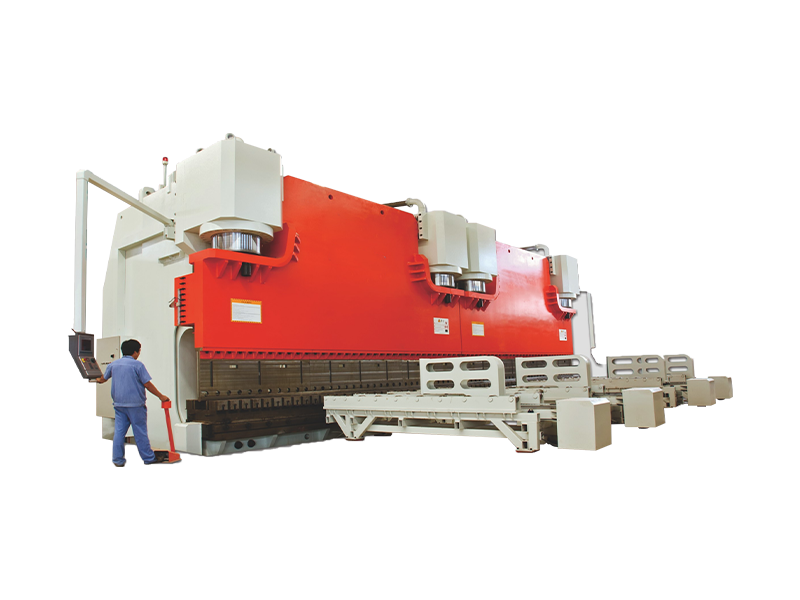
tandem press brake solves this by putting two machines in line and synchronising them. It is a well-established arrangement in elevator, curtain wall, rail vehicle and heavy enclosure work — and it is frequently misunderstood at the buying stage, because a tandem pair is not simply two brakes pushed together.
CNC Synchronized Tandem Press Brake
The Two Modes
Linked mode
In linked mode the two machines act as one long brake. Both rams move together, both backgauges track the same position, and the part is bent in a single stroke across the full length. This is how you bend a 7,000 mm elevator door panel or a 9,000 mm façade extrusion cover.
The control challenge is that two independent hydraulic systems must agree. Each machine has its own Y1 and Y2, so a linked pair is really four cylinders that must stay in step. Jianmeng's 2-WE67K platform addresses this with a shared CNC program and cross-machine position feedback, plus crowning calculated per machine and blended across the joint.
Independent mode
In independent mode the pair behaves as two separate press brakes. This is not a fallback — it is often the reason to buy a tandem pair at all. A shop that bends long panels for four hours a day and short brackets for the other four gets one investment that covers both, without tying up floor space for a machine that is only suitable for one job.
Switching between modes is a control function, not a mechanical change. The practical requirement is that tooling in both machines is at the same height and the same die opening, otherwise linked mode produces a step at the joint.
The Real Numbers
The 2-WE67K range in Jianmeng's catalogue starts at 3,200 kN per pair on a 6,000 mm bend length and runs to 30,000 kN on 7,000 mm. A representative slice:
|
Model |
Force (kN) |
Bend length (mm) |
Column distance (mm) |
Throat depth (mm) |
Stroke (mm) |
Open height (mm) |
|
2-WE67K-320/6000 |
3,200 |
6,000 |
4,800 |
720 |
250 |
830 |
|
2-WE67K-400/7000 |
4,000 |
7,000 |
5,600 |
720 |
320 |
830 |
|
2-WE67K-600/6000 |
6,000 |
6,000 |
4,800 |
1,000 |
320 |
960 |
|
2-WE67K-800/6000 |
8,000 |
6,000 |
4,800 |
1,100 |
350 |
1,250 |
|
2-WE67K-1000/7000 |
10,000 |
7,000 |
5,000 |
1,600 |
400 |
1,350 |
|
2-WE67K-1600/7000 |
16,000 |
7,000 |
5,600 |
1,600 |
450 |
1,550 |
Read the throat depth, not the tonnage
Throat depth on the
tandem range runs from 720 mm to 1,600 mm. That is far deeper than a standard brake, and it is deliberate: long parts with deep returns — elevator car panels, switchgear enclosures, marine modules — need the part to pass over the tooling without fouling the frame. A 16,000 kN pair with a shallow throat cannot bend a deep box any better than a 3,200 kN pair.
Speed drops as force rises
Ram speed falls from 70 mm/s on the 320-tonne pair to 60 mm/s on the 30,000 kN model, and the working speed from 7.5 mm/s to 5 mm/s. On long heavy parts, the handling time usually dominates anyway, so this rarely changes the production rate — but it does change the machine's suitability for thin-gauge high-volume work, where a tandem pair is the wrong tool.
Tandem or One Long Bed?
|
Criterion |
Tandem pair |
Single long-bed machine |
|
Maximum practical length |
9,000 mm and beyond |
Around 8,000 mm before structure becomes unwieldy |
|
Utilisation |
Two modes, linked and independent |
One mode only |
|
Shipping and installation |
Two standard frames, easier freight |
Oversize load, crane and route planning |
|
Bed deflection |
Two shorter spans, easier to compensate |
One long span, compensation harder |
|
Alignment |
Joint must be set and maintained |
No joint |
|
Floor space |
Slightly more in total |
More in one block |
|
Spare capacity |
One machine can run while the other is serviced |
Full stop for any service |
The joint is the trade-off. Two frames bolted and aligned to act as one introduces a line where there was none, and that line must be maintained. On a single long bed there is no joint, but everything else about the machine is harder.
Installation: Where Tandem Pairs Fail
Most tandem problems are installation problems, not machine problems.
Foundation and leveling
Both frames must sit on a foundation designed for the combined load, and both must be level to the same reference — not individually level, but level relative to each other. A 0.1 mm height difference at the joint shows as a visible step on a full-length bend. Use a single reference datum for both machines, and re-check after the first month of production.
Alignment of the joint
The two beds must be coplanar and the two rams parallel within tolerance across the joint. Verify with a straight edge and dial indicator spanning both beds, at the left, the joint and the right. This is the measurement that determines whether linked mode is usable at all.
Tooling height matching
Linked mode requires the punch tips in both machines at the same height. If one machine has a slightly different die stack, the controller will compensate the ram but the part will still show a kink. Standardise on one tooling system and one die height across both machines.
Electrical and hydraulic coordination
Two hydraulic power units, one control architecture. Confirm that the link between the controls is documented, that a fault in one machine safely stops the pair in linked mode, and that independent mode can be entered without a full re-commission.
Safety With Two Rams in One Line
A tandem pair creates a hazard that a single machine does not: an operator standing between the two machines is inside two closing rams. Practical requirements:
• Light curtains or laser guards covering the gap between the frames, not just the front of each machine.
• A physical barrier or interlock preventing access to the joint zone during linked operation.
• Two-hand control or foot pedal logic that cannot start one machine while the other is in motion.
• Clear floor marking for the part path, since long panels swing wide when handled.
Working With Jianmeng
Jianmeng Intelligent Equipment (Taizhou) Co., Ltd. has built sheet metal machinery in Jiangsu for over 30 years, holds more than 50 patents, and produces roughly 300 machines a year from an 8,500 m² plant for a customer base of 3,500-plus companies. The tandem range is part of a press brake line that also includes electro-hydraulic synchronous, dual servo hybrid, torsion bar NC and mini servo electric platforms, so a tandem pair can be specified with the same Delem, Cybelec, ESA or Laimore control family as the rest of the shop.
For a fabricator moving into 7,000 mm work, the useful first question is how often the machine will actually run at full length. If the answer is most days, a tandem pair earns its keep through the independent mode alone.




 English
 中文
 Arabic
 Russian
 Spanish
 Portuguese
 French
 German
 Hindi
 Thai
 Vietnamese
 Khmer
 Italian
 Turkish
 Korean
 Belarusian