Robotic Press Brake Bending Cell: Planning Before Buying
Release time:2026-11-23
Visits:1
A
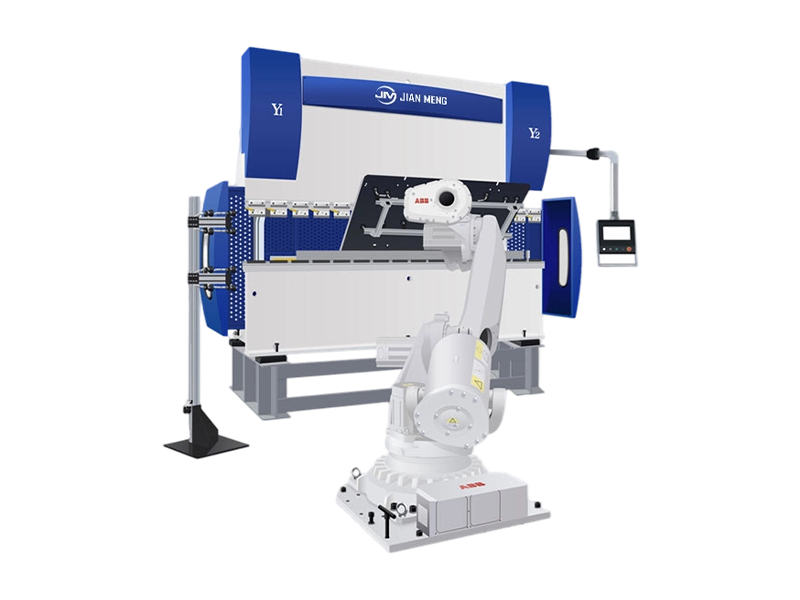
robotic press brake bending cell is not a press brake with a robot bolted to the side. It is a small automated production system in which the brake is one component, and the component that usually determines the throughput is not the brake at all — it is the material handling.
Robotic press brake bending cell
Shops that buy a cell and are disappointed almost always made the same mistake: they costed the robot and the brake, and forgot to count how many seconds each sheet spends being picked, separated, centred, turned and stacked.
What Is Actually in the Cell
The robot and its seventh axis
A bending cell uses an industrial robot on a linear seventh axis, which lets it travel along the length of the brake rather than reaching everything from one fixed point. That travel is what makes long parts possible: without it, the robot's reach limits the bend length.
Jianmeng's cell is built around a
hybrid servo press brake with seventh-axis robot control and offers STEP, ABB or KAWASAKI robots depending on the region and the integration preference, at 63 to 600 tonnes with Delem, Cybelec or ESA control.
Grippers
Grippers are customised to the workpiece, with two sets of standard grippers supplied as a starting point. This is where most of the engineering effort goes, and it is the reason a cell is a project rather than a purchase. A gripper that works on a 300 × 200 mm bracket will not pick a 1,200 × 400 mm panel with a 40 mm return flange, and no amount of programming fixes a bad grip.
Centering table
The robot picks from the raw material stack — separating one sheet from the next magnetically or mechanically — and places it on a centering table. The table tilts so the sheet slides into a fixed datum corner, which gives a repeatable starting position without vision. That single component is what makes the rest of the program possible.
Turnover table
Parts that need bending on both faces require the sheet to be flipped. The robot places the workpiece on a front suction cup, then grips it from the reverse side. Doing this in a fixed, known location is far more reliable than trying to flip in mid-air.
Sheet thickness measurement and closed-loop bending
The cell measures sheet thickness and uses a bending servo system so the ram depth can be corrected per part. This is not a luxury: coil-to-coil thickness variation is the main reason an automated line drifts out of angle tolerance overnight, and a human operator corrects for it instinctively in a way a robot cannot.
The Cycle Time Calculation
Take a real example: a 400 × 300 mm bracket in 1.5 mm galvanised steel, four bends.
|
Step |
Seconds |
|
Pick from stack and separate |
4 |
|
Place on centering table, centre |
5 |
|
Move to brake, position for bend 1 |
4 |
|
Bend 1 (approach, bend, return) |
4 |
|
Reposition for bend 2 |
3 |
|
Bend 2 |
4 |
|
Reposition for bend 3 |
3 |
|
Bend 3 |
4 |
|
Turnover for bend 4 |
7 |
|
Bend 4 |
4 |
|
Unload to stack |
4 |
|
Total per part |
46 |
At 46 seconds the cell produces about 78 parts an hour, or roughly 620 in an eight-hour shift. A skilled operator on the same part might manage 55–65 parts an hour including handling — so the gain is real but not dramatic on a simple part.
Where the cell wins decisively
The advantage grows with part weight and with the number of bends. A 6 kg panel that two people struggle to turn is a straightforward job for a robot. A part with eight bends has eight repositioning moves, all of which the robot does without fatigue. And on the night shift, the cell's output is identical to its day-shift output, which is the argument that usually closes the business case.
Where it loses
• Very small parts. Below about 100 mm, gripper design and drop accuracy become the bottleneck.
• Very short runs. Programming and gripper changeover for a 50-piece order can exceed the manual time.
• Cosmetic surfaces. Any gripper contact on a mirror-finish panel is a defect risk.
Layout and Integration
Floor space and material flow
A cell needs the brake, the robot track, the raw stack, the centering table, the turnover table and the finished-part stack — and it needs them arranged so the robot's longest move is short. Standard supporting configurations include a rear-gauge retrofit, fixtures, turning and centering tables, magnetic or mechanical separators, safety guards and the optional seventh axis.
Plan the raw material delivery as part of the cell. A robot that runs out of blanks at 02:00 has produced nothing for the last four hours of the shift.
Safety
A cell runs a guarded perimeter with light curtains at the load/unload openings. The design question is how the operator restocks without stopping production: a double-stack arrangement or a shuttle table lets the robot work one stack while the other is replenished.
Programming and part families
A cell is economical when the parts share a family — similar thickness, similar gripper envelope, similar bend sequences. Grouping parts this way lets one program template serve many drawings, which is how the setup time per order stays low.
Commissioning Checklist
|
Check |
Why it matters |
|
Gripper set covers the top 80% of parts by volume |
Otherwise the cell stops for every new part |
|
Centering repeatability measured over 50 sheets |
Sets the whole downstream accuracy |
|
Thickness measurement verified against a micrometer |
Drives the closed-loop bend correction |
|
Angle measured on first-off and last-off parts |
Confirms the closed loop is closing |
|
Restock time measured |
Determines real unattended hours |
|
Fault recovery documented |
A cell that needs an engineer for a dropped part is not automated |
Working With Jianmeng
Jianmeng Intelligent Equipment (Taizhou) Co., Ltd. has over 30 years in sheet metal machinery, more than 50 patents, an 8,500 m² plant and about 300 machines a year shipped to 3,500-plus customers across Asia, the Middle East, Europe and the Americas. The bending cell sits at the top of a press brake range that includes electro-hydraulic synchronous, dual servo hybrid, torsion bar NC, mini servo electric and tandem platforms, so the brake inside the cell can be matched to the part mix rather than forced into one drive type.
The practical advice for anyone considering a cell: take your five highest-volume parts, time them by hand, then time every handling step separately. If handling is more than half the total, the cell is worth studying. If it is 20%, a second manual brake will beat it on payback. Jianmeng runs this calculation with customers before quoting a cell, because a badly matched cell is expensive to own and hard to sell on.





 English
 中文
 Arabic
 Russian
 Spanish
 Portuguese
 French
 German
 Hindi
 Thai
 Vietnamese
 Khmer
 Italian
 Turkish
 Korean
 Belarusian