CNC Horizontal V Grooving Machine: The Plate Stays Still
Release time:2026-11-27
Visits:1
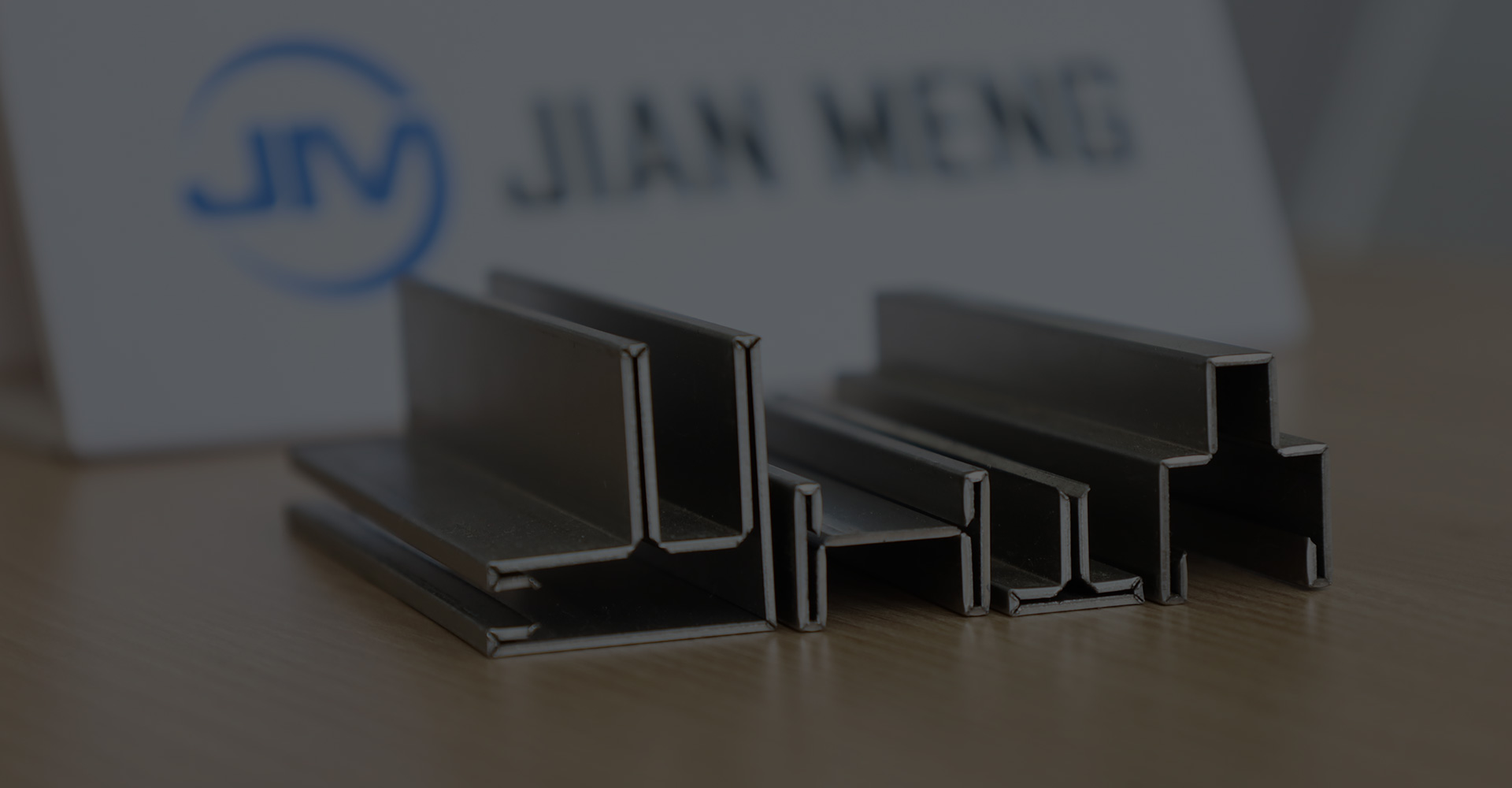
V-grooving exists because a press brake cannot produce a sharp outside corner. Bend 1.5 mm stainless over a standard V-die and the outside radius is roughly 1.5 mm — visible, and unacceptable on a door edge, a column cladding panel or a lift car return. Cut a V-shaped groove along the bend line first, and the material left at the root of the groove bends to a radius close to zero, giving a true right angle with a crisp arris.
A
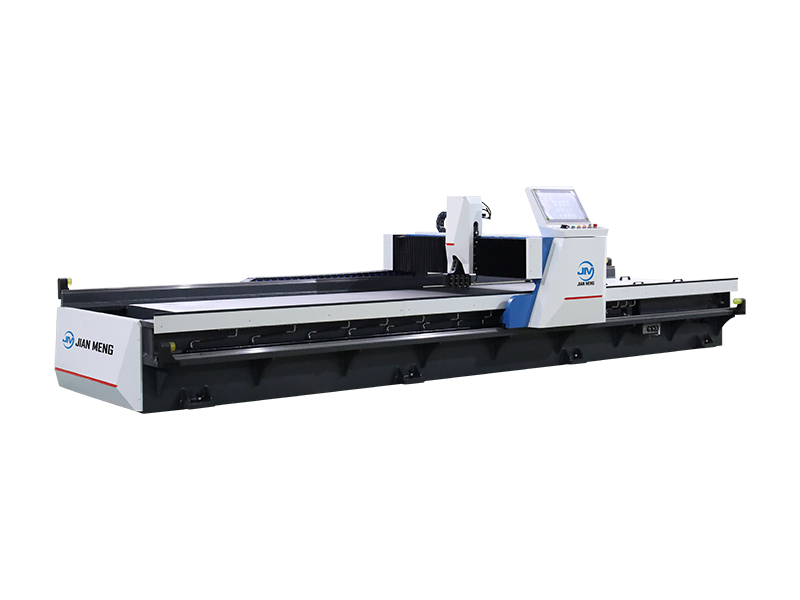
CNC horizontal V grooving machine is one of two ways to cut that groove. The other is vertical. The horizontal layout, where the sheet lies flat on a fixed table and the tool travels across it, is the older and still the more common arrangement for decorative and architectural work — and it has specific strengths that are easy to miss in a specification sheet.
How the Horizontal Layout Works
Plate clamped, tool moving
On a horizontal machine the sheet is clamped flat to a machined table by front and side pressure feet, and the tool holder traverses along the gantry. Because the plate never moves, there is no relative sliding between the sheet's underside and the table surface. That is the single most important property for mirror-finish and brushed stainless: any sliding contact leaves a mark that cannot be polished out without changing the finish.
Jianmeng's GSHM platform uses a horizontal gantry frame with the base and crossbeam tempered in an electric furnace to remove welding stress, then machined in a single clamping so that mounting surfaces are parallel and perpendicular. The table itself is low-alloy high-strength steel, planed flat.
Transmission and control
The crossbeam runs on a double-rail structure of ground helical gears and high-precision helical racks, driven by full servo motors. Maximum axis speed parallel to the X-axis is 120 m/min, and parallel to Y is 60 m/min. Repetitive positioning accuracy is quoted at 0.015 mm with a claimed grooving repeatability of ±0.02 mm.
Clamping that protects the surface
The hydraulic clamping system uses an extended movable presser foot, an accumulator for pressure compensation, and a motor no-load starting mode that keeps oil temperature stable. Adjustable clamping pressure matters on thin decorative sheet: too much pressure marks the surface, too little lets the plate lift as the tool exits the groove.
The Numbers
|
Model |
Sheet range (mm) |
Thickness (mm) |
Min groove-to-edge (mm) |
Table flatness (mm) |
X speed (m/min) |
Repeatability (mm) |
|
1232 |
1,250 × 3,200 |
0.4–5.0 |
8 (customised) |
±0.03 |
120 |
0.015 |
|
1240 |
1,250 × 4,000 |
0.4–5.0 |
8 (customised) |
±0.03 |
120 |
0.015 |
|
1532 |
1,500 × 3,200 |
0.4–5.0 |
8 (customised) |
±0.03 |
120 |
0.015 |
|
1540 |
1,500 × 4,000 |
0.4–5.0 |
8 (customised) |
±0.03 |
120 |
0.015 |
|
1560 |
1,500 × 6,000 |
0.4–5.0 |
8 (customised) |
±0.03 |
120 |
0.015 |
The 8 mm minimum groove-to-edge distance is the figure that most often decides feasibility. A 10 mm return flange on a 1.2 mm panel leaves only 10 mm of material outboard of the groove, and the clamping foot needs room to hold it. Customisation can reduce the distance, but it is a mechanical change, not a setting.
Groove Depth: the Number Nobody Agrees On
The principle
The groove removes material from the tension side of the bend. What remains — the web — determines both how sharp the corner looks and whether the part survives.
• Web too thick. The outside radius stays visible. The groove was decorative rather than functional.
• Web too thin. The bend cracks, or the corner collapses under load, or the part fails in service.
• Web correct. The corner closes to a radius under about 0.3 mm, the surface stays intact, and the bend passes a 180° fold test without a fracture.
A working table
|
Sheet thickness |
Typical web left |
Expected result |
|
0.5–0.8 mm |
0.15–0.25 mm |
Very sharp arris, needs careful handling |
|
1.0–1.5 mm |
0.25–0.35 mm |
Standard architectural corner |
|
2.0–3.0 mm |
0.35–0.50 mm |
Sharp corner with structural margin |
|
4.0–5.0 mm |
0.50–0.70 mm |
Groove mainly to control radius, not to thin the section |
These are starting points, not rules. The right value depends on the alloy, the temper and the bend direction relative to the rolling direction. Cut three test pieces at different depths and fold them to 90° before committing to a production program — it takes twenty minutes and prevents a rejected batch.
Groove angle and width
A 90° included angle suits a 90° bend. For a fold that must close further, a narrower included angle is used so the two groove faces meet before the outer surface tears. The tool geometry sets the angle; the CNC sets the depth.
Horizontal Versus Vertical
|
Criterion |
Horizontal |
Vertical |
|
Plate support |
Fully supported on a flat table |
Held vertically, edge-supported |
|
Surface marking risk |
Low — plate does not slide |
Low — plate moves, tool fixed |
|
Long thin panels |
Good, but table length limits |
Better for very long, narrow parts |
|
Large heavy sheets |
Easier to load flat |
Loading vertical is harder |
|
Thickness range |
0.4–5.0 mm typical |
0.4–6.0 mm typical |
|
Floor space |
Wider footprint |
Taller, narrower footprint |
|
Mirror finish |
Excellent |
Excellent |
The choice usually comes down to part shape and factory layout rather than to accuracy. A shop making large architectural panels loads them flat; a shop making long narrow trim profiles often prefers vertical.
The Tooling Detail That Controls Cost
Jianmeng's horizontal head uses an integrated tool holder with four blades distributed to even out the cutting load, plus a fully automatic self-lubricating system that operates as the holder moves up and down. Two practical consequences:
• Even blade wear. Four blades sharing the cut wear more slowly and more evenly than a single blade taking the full depth, which reduces both tool cost and the frequency of depth correction.
• Universal clamping interface. White steel and carbide tooling can both be mounted. Carbide lasts longer in stainless and aluminium; high-speed steel is cheaper and more forgiving in thin gauge where a chipped edge is less catastrophic.
An optional micro-cooling device extends tool life further. On a machine running three shifts in 1.5 mm stainless, the difference in tool consumption pays for the option within a year.
Working With Jianmeng
Jianmeng Intelligent Equipment (Taizhou) Co., Ltd. has been building sheet metal machinery in Jiangsu for over 30 years, with more than 50 patents, an 8,500 m² plant and roughly 300 machines a year shipped to more than 3,500 customers. The company produced its first gantry-type
CNC V-grooving machine in 2008 and introduced a four-side model in 2015, and the current grooving range covers horizontal, four-side, vertical, vertical reciprocating and vertical laser-combination platforms.
The horizontal V grooving machine in that range is the workhorse for architectural and decorative panel work, and the specification conversation tends to settle quickly once three numbers are known: sheet size, thickness range and the narrowest flange in the product family. Everything else — blade count, cooling, control screen size — follows from those.




 English
 中文
 Arabic
 Russian
 Spanish
 Portuguese
 French
 German
 Hindi
 Thai
 Vietnamese
 Khmer
 Italian
 Turkish
 Korean
 Belarusian