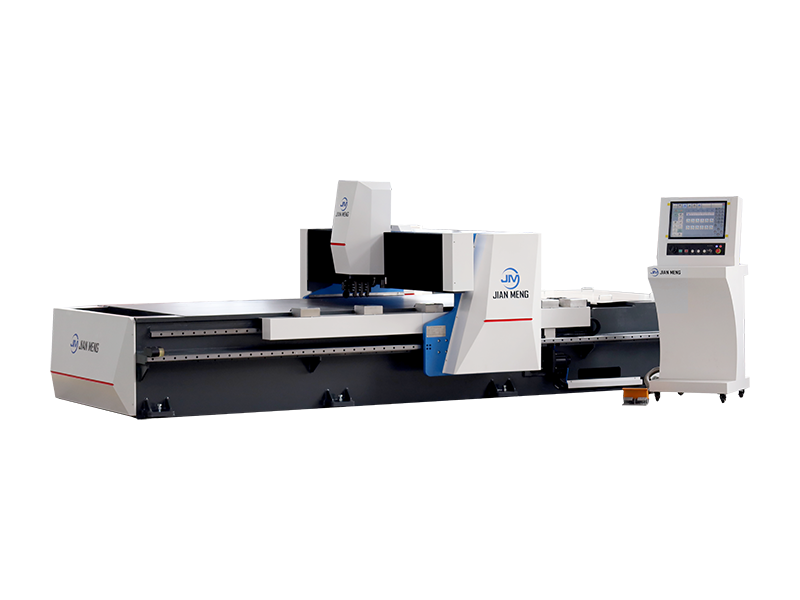
Automatic Four Side V-shaped Grooving Machine: One Setup, Four Sides
Release time:2026-11-30
Visits:1
A metal door leaf needs grooves on all four edges. So does a stainless cabinet wrap, a lift car panel and a column cover. On a single-head horizontal grooving machine, that means four separate setups: clamp, groove one side, release, rotate the sheet 90°, clamp again, groove, repeat. The grooving itself might take two minutes per side. The handling takes longer than the cutting, and every rotation introduces a positioning error that shows up later as a mismatched corner.
A
four side V-shaped grooving machine exists to delete that sequence. The sheet is loaded once, clamped once, and all four grooves are cut without the operator touching it again.
Automatic Four Side V-shaped Grooving Machine
The Mechanism That Makes It Possible
Rotating tool holder
Instead of rotating the sheet, the machine rotates the tool. A turret-style holder turns through 90° increments, locks hydraulically, and presents the cutting head to each edge in turn. Because the sheet never moves after clamping, the position of every groove is referenced to the same datum — which is exactly why corner alignment improves.
The turret uses a hydraulic chuck locking arrangement with high rotational accuracy and stable positioning. That locking is the critical detail: a turret that creeps by a few hundredths between sides produces grooves that do not meet cleanly at the corner, and the resulting bend shows a notch.
Five-axis CNC and full servo drive
The four side machine uses five-axis CNC with full servo drive on all axes. In practice that means:
• Automatic calculation of groove spacing from the entered panel dimensions.
• Visual programming on a 19-inch industrial touchscreen.
• A preview of the bending result before a single cut is made.
• One-click tool change and one-click automatic cycle.
Three knives cutting at once
The rotating head carries three knives working simultaneously, which distributes cutting force across the groove and reduces the risk of workpiece deformation. A single knife taking the full depth in one pass pushes the material ahead of it; three knives sharing the cut keep the groove walls straight and the depth uniform.
The Numbers
|
Model |
Sheet range (mm) |
Thickness (mm) |
Min groove-to-edge (mm) |
Table flatness (mm) |
X speed (m/min) |
Y speed (m/min) |
Repeatability (mm) |
|
1232 |
1,250 × 3,200 |
0.4–5.0 |
8 (customised) |
±0.03 |
120 |
60 |
0.015 |
|
1240 |
1,250 × 4,000 |
0.4–5.0 |
8 (customised) |
±0.03 |
120 |
60 |
0.015 |
|
1532 |
1,500 × 3,200 |
0.4–5.0 |
8 (customised) |
±0.03 |
120 |
60 |
0.015 |
|
1540 |
1,500 × 4,000 |
0.4–5.0 |
8 (customised) |
±0.03 |
120 |
60 |
0.015 |
|
1560 |
1,500 × 6,000 |
0.4–5.0 |
8 (customised) |
±0.03 |
120 |
60 |
0.015 |
The Throughput Case
Take a standard door leaf: 900 × 2,100 mm, 1.2 mm stainless, four grooves, one per side.
|
Step |
Single-head horizontal |
Four side automatic |
|
Load and clamp |
60 s |
60 s |
|
Groove side 1 |
45 s |
45 s |
|
Release, rotate, reclamp |
90 s |
— |
|
Groove side 2 |
45 s |
45 s |
|
Release, rotate, reclamp |
90 s |
— |
|
Groove side 3 |
45 s |
45 s |
|
Release, rotate, reclamp |
90 s |
— |
|
Groove side 4 |
45 s |
45 s |
|
Unload |
30 s |
30 s |
|
Total |
540 s |
270 s |
The saving is not in cutting speed — the spindle does the same work either way. It is entirely in the three rotations and reclamps, which is also where the dimensional error comes from. Halving the cycle roughly doubles output per shift, and the corner alignment is better on top of it.
The real constraint: the operator
On a single-head machine the operator is busy for most of the 540 seconds. On the four side machine, the operator loads, presses cycle, and walks away for four minutes. One person can therefore tend two four side machines, which changes the labour cost per panel far more than the cycle time does.
Accuracy Details Worth Specifying
Table flatness
±0.03 mm across the table is the foundation of groove depth consistency. If the table is not flat, a fixed tool height produces a groove that is deep in the middle and shallow at the edges, and the bend angle varies along the fold.
Groove-to-edge distance
8 mm is the standard minimum, customisable downward. This matters most on narrow return flanges — a 12 mm flange on a cabinet side panel leaves very little room for the clamping foot.
Clamping arrangement
The
four side machine uses multiple front pressure feet with pneumatic clamping, plus movable side pressure feet with an automatic evasive function. During horizontal machining the holder lowers the blade close to the side foot, keeping clamping force where it is needed and avoiding the "flying board" failure where a loosely held sheet lifts as the tool exits.
The transmission module is fully enclosed to prevent metal swarf from being drawn in — a detail that matters in a shop where the machine runs continuously and swarf accumulates.
Software
Jianmeng's proprietary grooving software runs on Windows with a 19-inch industrial touchscreen and covers longitudinal and lateral processing in a single pass, automatic dimension calculation, bending diagram preview, hand-drawn graphics input, automatic capacity calculation, one-click automatic cycle and one-click tool change. Hand-drawn input is more useful than it sounds: on bespoke architectural work, the drawing often arrives as a sketch, and being able to key in a shape rather than program coordinates saves a step.
Where the Four Side Machine Fits
An
Automatic Four Side V-shaped Grooving Machine is a production tool rather than a general-purpose one, and Jianmeng's applications team uses the criteria below to separate the shops that need one from the shops that do not.
It is the right machine when:
• The part has grooves on three or four edges — doors, wraps, cladding cassettes, lift panels.
• Batch sizes are moderate to large, so programming time amortises.
• Corner alignment is visible and inspected.
• One operator needs to run more than one machine.
It is the wrong machine when parts are long and narrow (a vertical machine handles those better), when only one edge is grooved (a horizontal single-head is cheaper), or when thickness regularly exceeds 5 mm.
Working With Jianmeng
Jianmeng Intelligent Equipment (Taizhou) Co., Ltd. built its first gantry-type CNC V-grooving machine in 2008 and introduced a four side machine in 2015 — the platform has had a decade of field refinement since. The company has over 30 years in sheet metal machinery, more than 50 patents, an 8,500 m² plant and roughly 300 machines a year going to 3,500-plus customers, with recent four side units shipped to Korean door and panel producers.
For a fabricator whose bottleneck is door or cassette production, the useful calculation is panels per shift rather than metres per minute. On that measure, the four side machine's advantage comes almost entirely from the rotations it eliminates.




 English
 中文
 Arabic
 Russian
 Spanish
 Portuguese
 French
 German
 Hindi
 Thai
 Vietnamese
 Khmer
 Italian
 Turkish
 Korean
 Belarusian