Vertical CNC V-Grooving Machine For Stainless Steel Sheets
Release time:2026-12-04
Visits:1
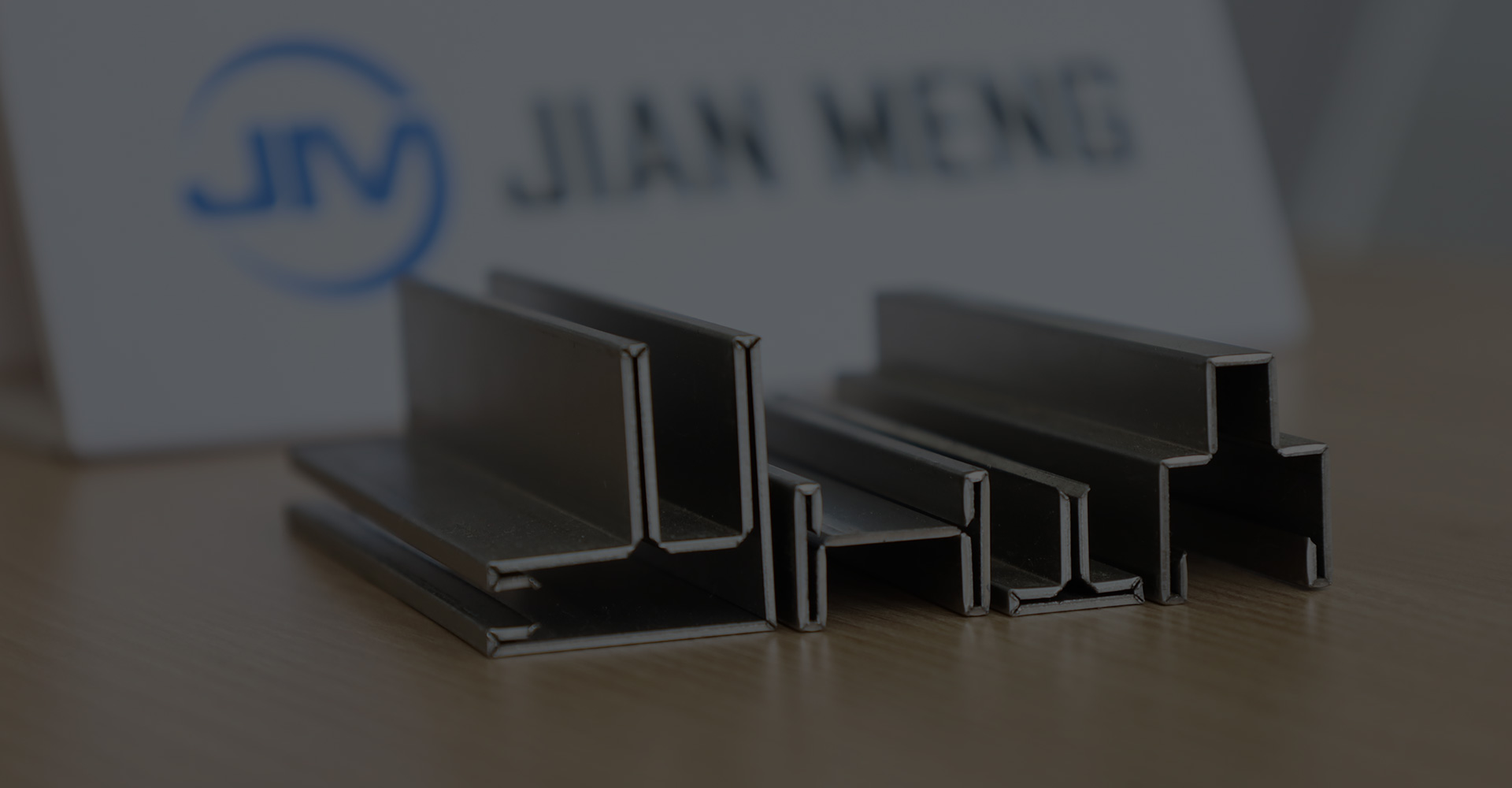
Stainless is the material that made V-grooving a standard process. A 1.2 mm 304 panel bent over a conventional die leaves an outside radius of roughly 1.2 mm, and on a mirror-polished surface that radius reads as a soft, slightly dulled edge where the customer expected a crisp arris. Grooving removes the material that would have formed that radius, and the fold closes to a near-zero corner.
The vertical arrangement is the version most often chosen for stainless work in Europe and Asia, and the reasons are structural rather than stylistic.
Fixed Tool, Moving Sheet
The kinematic difference
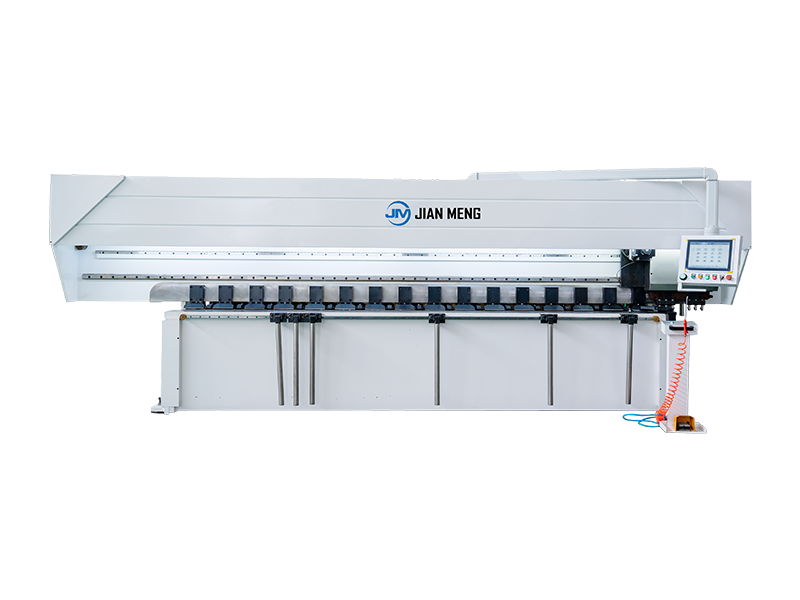
On a vertical machine the tool holder stays where it is and the sheet is driven past it on a carriage. The sheet is held in a vertical plane, clamped along its lower edge and supported by the table.
That reverses which component carries the positioning error. On a horizontal machine the tool travels and the plate is fixed; on a vertical machine the plate travels and the tool is fixed. For long, narrow stainless parts — trim profiles, column returns, handrail cladding — moving a light sheet is easier than moving a heavy gantry, and the machine footprint is narrower for the same working length.
The table is the wear part
Jianmeng's vertical platform uses a carbon tool steel worktable, high-frequency quenched to 55–60 HRC. That hardness is deliberately higher than the stainless being processed, because the failure mode on a vertical machine is table wear: the sheet slides across it thousands of times, and a soft table develops polished tracks that transfer to the workpiece.
Table flatness is held to ±0.03 mm, which is what keeps groove depth consistent along a 6,000 mm panel.
No marks on mirror plate
The
vertical machine's frame is tempered in an electric furnace to relieve welding stress, then clamped and machined in one pass on an imported CNC machining centre so that every mounting surface is parallel and perpendicular. The table surface is described as an integrated bottom film formed in one go, which allows processing on mirror plate without leaving marks. For a shop supplying lift interiors or architectural feature walls, that claim is the one to test first — bring a piece of No. 8 mirror finish and inspect it under raking light after grooving.
The Range
|
Model |
Sheet range (mm) |
Thickness (mm) |
Min groove-to-edge (mm) |
Table flatness (mm) |
X speed (m/min) |
Repeatability (mm) |
|
1232 |
1,250 × 3,200 |
0.4–6.0 |
10 (customised) |
±0.03 |
120 |
0.015 |
|
1240 |
1,250 × 4,000 |
0.4–6.0 |
10 (customised) |
±0.03 |
120 |
0.015 |
|
1532 |
1,500 × 3,200 |
0.4–6.0 |
10 (customised) |
±0.03 |
120 |
0.015 |
|
1540 |
1,500 × 4,000 |
0.4–6.0 |
10 (customised) |
±0.03 |
120 |
0.015 |
|
1560 |
1,500 × 6,000 |
0.4–6.0 |
10 (customised) |
±0.03 |
120 |
0.015 |
Note the 6.0 mm thickness ceiling, against 5.0 mm on the horizontal platform, and the 10 mm minimum groove-to-edge distance, against 8 mm horizontal. Those two differences are the practical reason a shop with both stainless and aluminium work sometimes ends up with one of each.
Drive train
The vertical machine uses full servo motors with planetary gearboxes for high torque and fast response, and the crossbeam runs on a double-rail structure of ground helical gears and high-precision helical racks with variable frequency speed regulation. The result is stable high-speed feed without the judder that shows up as a ripple in the groove wall.
Stainless Behaviour, Grade by Grade
Grooving parameters that work on one stainless grade do not transfer directly to another. The differences are worth knowing before a production program is written.
|
Grade |
Grooving behaviour |
What to watch |
|
304 |
Predictable, good chip form |
Work hardening if feed is too light; keep the cut loaded |
|
316 / 316L |
Slightly tougher, more tendency to gall |
Carbide tooling preferred; cooling helps |
|
201 |
Harder and more springy than 304 |
Groove may need to be slightly deeper to close fully |
|
430 |
Ferritic, less ductile |
Risk of cracking at the groove root on tight folds |
|
304 with protective film |
Film can trap swarf |
Trim the film back from the groove line |
Work hardening is the trap
Stainless work hardens where it is rubbed rather than cut. A tool that skims the surface with insufficient depth per pass polishes the groove wall into a hard layer, and the next pass wears the blade instead of cutting metal. The cure is to keep the cut loaded — a deeper single pass with three blades sharing the load, which is exactly how the vertical head is arranged.
Springback after grooving
A grooved stainless panel springs back less than an ungrooved one, because most of the elastic material on the tension side has been removed. Operators used to adding springback compensation on the press brake often over-bend the first few parts. Set the brake from a test fold, not from a table.
Setup and Operation
Programming
The control runs Jianmeng's proprietary grooving software on Windows with a 15-inch industrial touchscreen: automatic dimension calculation, bending diagram preview, hand-drawn graphics input, automatic capacity calculation, one-click automatic cycle and one-click tool change. Groove depth and groove spacing are entered directly, and the software converts them into axis positions.
Clamping
Hydraulic clamping with dense pressure feet along the table holds the sheet against the tool. On thin stainless the clamp pressure needs to be adjustable: enough to prevent the sheet lifting as the blade exits, not so much that the surface marks. Confirm the pressure range covers your thinnest gauge before ordering.
Tooling
The integrated tool holder uses a three-blade distribution with a fully automatic self-lubricating system that operates as the holder moves. Three blades share the cutting load, which reduces deformation and extends life. A universal clamping interface accepts both white steel and carbide, and an optional micro-cooling device extends life further on continuous stainless production.
Common Problems and Their Causes
|
Symptom |
Likely cause |
Fix |
|
Groove depth varies along the panel |
Table flatness or sheet not seated |
Check table with a straight edge; clean the table |
|
Visible ripple in the groove wall |
Feed speed too high or gearbox backlash |
Reduce feed; check rack preload |
|
Corner does not close fully |
Groove too shallow for the grade |
Increase depth 0.05 mm and re-test |
|
Cracking at the fold |
Groove too deep, or 430 material |
Reduce depth; anneal or change grade |
|
Surface marks on mirror plate |
Clamp pressure or swarf on the table |
Reduce pressure; clean between sheets |
Working With Jianmeng
Jianmeng Intelligent Equipment (Taizhou) Co., Ltd. has over 30 years in sheet metal machinery, more than 50 patents, an 8,500 m² production facility and around 300 machines a year going to a customer base above 3,500 companies across Southeast Asia, the Middle East, Europe and the Americas. Its grooving range covers horizontal, four side, vertical, vertical reciprocating and vertical laser-combination machines — the first gantry-type CNC grooving machine was built in 2008, so the vertical platform has a long production history behind it.
Vertical CNC V-Grooving Machine for Stainless Steel Sheets
For stainless work specifically, the two questions that decide the model are the longest panel in the product family and the thinnest gauge. Everything else — blade count, cooling, control size — can be adjusted around those. A
Vertical CNC V-Grooving Machine for Stainless Steel Sheets makes sense when the panel is long and the finish is visible, and that combination is what Jianmeng's vertical range is built around.





 English
 中文
 Arabic
 Russian
 Spanish
 Portuguese
 French
 German
 Hindi
 Thai
 Vietnamese
 Khmer
 Italian
 Turkish
 Korean
 Belarusian