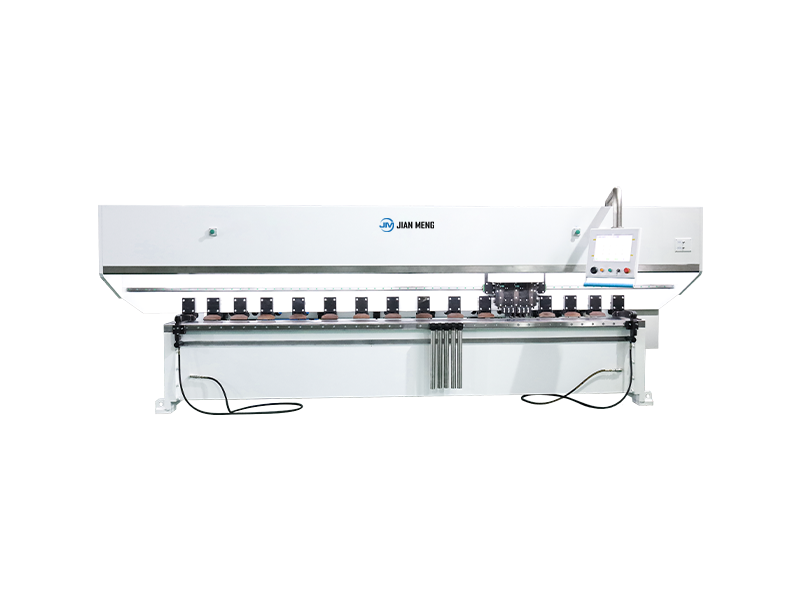
High-Speed Reciprocating Vertical V-Grooving Machine
Release time:2026-12-07
Visits:0
Every grooving cycle has a return stroke. On a single-head machine the tool cuts along the panel, lifts or reverses, travels back to the start, and cuts again. That return is pure overhead — the spindle is turning, the hydraulics are loaded, the operator is waiting, and no material is being removed.
On thick plate, where cutting speed is limited by tool load rather than by axis speed, that overhead can approach half the cycle. A reciprocating machine attacks it directly by putting a second head on the crossbeam so that one head cuts while the other returns.
The Reciprocating Principle
Two heads, alternating
The crossbeam carries two
grooving heads facing opposite directions. As head A travels left to right cutting a groove, head B travels right to left returning to its start position. On the next pass the roles swap. Because both heads are always in motion and one of them is always cutting, the return stroke is no longer dead time.
The consequence is a machine whose output on a multi-groove panel is roughly twice that of an equivalent single-head unit, without increasing axis speed. On 4 mm and 6 mm stainless, where the tool is already working hard, that is the only way to gain throughput without sacrificing groove quality.
Where the gain is largest
• Thick plate. 3–6 mm stainless and 4–6 mm aluminium, where feed rate is tool-limited.
• Many parallel grooves. Louvre panels, perforated-look facades, decorative banding.
• Long panels. The longer the groove, the larger the absolute time saved per pass.
Where the gain is smallest: thin gauge at maximum axis speed, where the axis is already the limit and a second head adds nothing.
The Machine
|
Model |
Sheet range (mm) |
Thickness (mm) |
Min groove-to-edge (mm) |
Table flatness (mm) |
X speed (m/min) |
Y speed (m/min) |
Repeatability (mm) |
|
1232 |
1,250 × 3,200 |
0.4–6.0 |
10 (customised) |
±0.03 |
120 |
60 |
0.015 |
|
1240 |
1,250 × 4,000 |
0.4–6.0 |
10 (customised) |
±0.03 |
120 |
60 |
0.015 |
|
1532 |
1,500 × 3,200 |
0.4–6.0 |
10 (customised) |
±0.03 |
120 |
60 |
0.015 |
|
1540 |
1,500 × 4,000 |
0.4–6.0 |
10 (customised) |
±0.03 |
120 |
60 |
0.015 |
|
1560 |
1,500 × 6,000 |
0.4–6.0 |
10 (customised) |
±0.03 |
120 |
60 |
0.015 |
Structure and drive
The frame is a vertical structure tempered in an electric furnace to relieve welding stress, then clamped and machined in one pass on a CNC machining centre so mounting surfaces are parallel and perpendicular. The worktable is carbon tool steel, high-frequency quenched to 55–60 HRC, flat to ±0.03 mm, with an integrated bottom film formed in one operation so mirror plate can be processed without marking.
Full servo motors with planetary gearboxes drive the axes; the crossbeam runs on a double-rail structure of ground helical gears and high-precision helical racks with variable frequency speed regulation. Positioning repeatability is 0.015 mm and grooving repeatability is quoted at ±0.02 mm.
Control and tooling
The control runs Jianmeng's grooving software on Windows with a 15-inch industrial touchscreen — automatic dimension calculation, bending diagram preview, hand-drawn graphics input, automatic capacity calculation, one-click automatic cycle, one-click tool change. The head uses an integrated tool holder with three-blade distribution and a fully automatic self-lubricating system, and the universal clamping interface accepts white steel or carbide.
Capacity Maths
Take a 1,500 × 3,000 mm, 4 mm stainless panel with six parallel grooves 2,800 mm long.
Single head. At a feed rate limited to about 8 m/min in 4 mm stainless — 133 mm per second — one 2,800 mm groove takes 21 seconds. Add 6 seconds to lift, return and index. Six grooves: 6 × 27 = 162 seconds, plus 70 seconds of loading and unloading, giving 232 seconds or about 3.9 minutes per panel. That is roughly 15 panels an hour.
Reciprocating dual head. The cutting pass still takes 21 seconds, but the return is absorbed by the other head, which is already in position at the opposite end. The only dead time is the 2-second lateral index between grooves. Six grooves: 6 × 23 = 138 seconds, plus the same 70 seconds of handling, giving 208 seconds — about 17 panels an hour.
So on long grooves the gain is real but modest, around 11%. Cutting time dominates the cycle and the single-head return is a small fraction of it.
The picture changes completely when grooves are short and numerous. Take a louvre panel with twenty 400 mm grooves. Single head: 3 seconds to cut, 6 seconds to return and index, 9 seconds per groove, 180 seconds total. Reciprocating: 3 seconds cutting while the other head returns, 1 second to index, 4 seconds per groove, 80 seconds total. The saving is 55%, because the return stroke was the majority of the work.
The rule of thumb
Reciprocating pays when the index and return time is a significant fraction of the cutting time — that is, when grooves are short, when there are many of them, or when the material is thick enough to slow the cut. On long, few, thin grooves, a single head at 120 m/min is already efficient.
Tool Life and Maintenance
Two heads mean twice the tool consumption per hour of operation, and the maintenance schedule has to reflect it.
|
Item |
Interval |
Note |
|
Blade inspection |
Every shift |
Chipped edges show as a bright line in the groove |
|
Blade rotation / index |
Per tool life |
Three-blade holder distributes wear |
|
Self-lubrication check |
Weekly |
Verify oil reaches the holder through full stroke |
|
Table cleanliness |
Every shift |
Swarf under the sheet causes depth variation |
|
Rack and gear preload |
Quarterly |
Loose preload shows as a ripple in the groove |
|
Clamp pressure verification |
Monthly |
Pressure drift marks thin sheet |
|
Crossbeam level check |
Annually |
Affects depth consistency across the width |
The symmetry check
A reciprocating machine has one property a single-head machine does not: the two heads must produce identical grooves. If head A is set 0.03 mm deeper than head B, alternating passes produce a panel whose grooves differ, and the fold angles will differ with them. Check by grooving a test plate with both heads on the same program and measuring depth at four points.
Safety and Handling Notes
• Long stainless panels are heavy and flexible; support them along the full length during loading, and never let a panel hang unsupported from the clamps.
• The two heads create two hazard zones on one crossbeam. Guarding must cover the full travel, not just the operator's normal side.
• Mirror-finish panels should be handled with clean gloves; a fingerprint etched into the surface during loading survives every subsequent process.
Working With Jianmeng
Jianmeng Intelligent Equipment (Taizhou) Co., Ltd. has over 30 years in sheet metal machinery and more than 50 patents, producing around 300 machines a year from an 8,500 m² plant for a customer base above 3,500 companies. Its grooving range runs from the first gantry-type CNC machine built in 2008 through horizontal, four side, vertical, vertical reciprocating and vertical laser-combination platforms, so the reciprocating model can be specified alongside the single-head version for a shop that needs both thin-gauge speed and thick-plate capacity.
High-Speed Reciprocating Vertical V-Grooving Machine
The decision between them usually comes down to one number: what share of the cycle is spent not cutting. Measure it on your own parts before choosing. A
High-Speed Reciprocating Vertical V-Grooving Machine is worth its price only where the return stroke is a large share of the cycle, which is the first question Jianmeng asks before quoting one.




 English
 中文
 Arabic
 Russian
 Spanish
 Portuguese
 French
 German
 Hindi
 Thai
 Vietnamese
 Khmer
 Italian
 Turkish
 Korean
 Belarusian