Integrated V-Grooving & Laser Cutting Combo Machine
Release time:2026-12-11
Visits:0
A stainless door leaf passes through two processes before it is bent: it is cut to outline, and its edges are grooved. Traditionally those happen on two machines in two locations, with a stack of panels waiting between them. Every transfer costs handling time, every reclamp costs accuracy, and every queue costs working capital sitting on the floor.
An
integrated V-grooving and laser cutting combo machine puts both operations on one frame, under one control, with one setup. The claim is not that it does either job better than a dedicated machine — it is that removing the transfer changes the economics of the whole panel.
Integrated V-Grooving & Laser Cutting Combo Machine
Why Combine Them
One datum for two processes
When a panel is cut on a laser and then moved to a grooving machine, it is located twice. The laser locates from the sheet edge or from a nest reference; the grooving machine locates from its own clamps. Any difference between those two references becomes a groove that is not exactly where the cut expects it, and on a part where the groove must sit 8 mm from a cut edge, that difference is visible.
On a combo machine the sheet is loaded once and both operations reference the same coordinate system. Groove-to-edge distance becomes a programmed value rather than an accumulated tolerance.
Laser cutting accuracy versus shearing
Jianmeng's combo uses a laser cutting head for the outline and quotes cutting accuracy of ±0.1 mm, against roughly ±0.5 mm for conventional shearing. On a panel where the fold line must meet a cut edge cleanly — a lift car return, a cabinet wrap, an aluminium curtain wall cassette — that difference is the whole point.
No process switch
The machine quotes an 80% reduction in process switching and a threefold improvement in overall efficiency compared with running the two operations separately. Those numbers are the vendor's, and they depend heavily on part mix. The mechanism behind them is straightforward: no destacking, no transport, no re-clamping, no waiting for the other machine to be free.
What Is on the Machine
The laser head
A fibre laser cutting head mounted on the same gantry as the grooving head, with dust and smoke extraction. Cutting gas and extraction are the two utilities that most often get underestimated at installation — plan the extraction duct route before the machine lands.
The grooving head
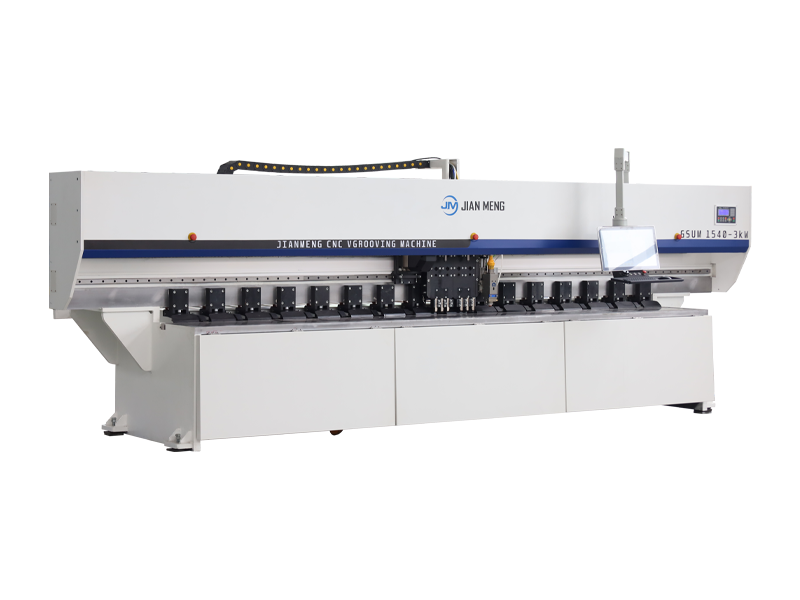
The grooving side uses the same architecture as Jianmeng's vertical grooving platform: three-blade integrated tool holder, fully automatic self-lubricating system, universal clamping interface for white steel or carbide tooling, and an optional micro-cooling device.
Control
A 21-inch industrial touchscreen running the proprietary control software, with direct CAD import. That last feature is what makes a combo machine practical: on bespoke architectural work the drawing already exists as a DXF, and importing it removes a manual programming step that would otherwise be repeated for every panel.
Air supply
The machine requires a compressed air supply from the customer. Specify the flow and pressure requirement at order stage rather than discovering it at commissioning.
The Specification
The Integrated V-Grooving & Laser Cutting Combo Machine is built in five working widths, all sharing the same head architecture:
|
Model |
Sheet range (mm) |
Thickness (mm) |
Min laser-to-edge (mm) |
Min groove-to-edge (mm) |
Cutting accuracy (mm) |
Repeatability (mm) |
|
1232 |
1,250 × 3,200 |
0.4–5.0 |
25 (customised) |
8 (customised) |
±0.1 |
0.015 |
|
1240 |
1,250 × 4,000 |
0.4–5.0 |
25 (customised) |
8 (customised) |
±0.1 |
0.015 |
|
1532 |
1,500 × 3,200 |
0.4–5.0 |
25 (customised) |
8 (customised) |
±0.1 |
0.015 |
|
1540 |
1,500 × 4,000 |
0.4–5.0 |
25 (customised) |
8 (customised) |
±0.1 |
0.015 |
|
1560 |
1,500 × 6,000 |
0.4–5.0 |
25 (customised) |
8 (customised) |
±0.1 |
0.015 |
The 25 mm minimum laser-to-edge distance is the constraint that catches people out. A laser head needs clearance from the sheet edge for the nozzle and for the extraction shroud, so a 15 mm return flange cannot be laser-cut on this machine — it would be sheared or cut on a different process. Check the narrowest flange in the product family against 25 mm before specifying.
The Cost Case
What the combo removes
|
Cost element |
Two machines |
Combo machine |
|
Floor space |
Two footprints plus a buffer zone |
One footprint |
|
Handling per panel |
Destack, transport, load, clamp twice |
Load once |
|
Labour |
Two operators or one walking between |
One operator |
|
WIP between processes |
Stacks waiting |
None |
|
Reference error between cut and groove |
Accumulates |
Eliminated |
|
Programming |
Two programs, two setups |
One CAD import |
What it does not remove
• Cutting speed. A dedicated fibre laser will out-cut a combo head on pure cutting throughput.
• Thickness ceiling. 5.0 mm on the combo, against 6.0 mm on a dedicated vertical grooving machine.
• Narrow flanges. The 25 mm laser clearance is a hard constraint.
When it pays
The combo machine earns its price when panels need both operations, when the part has features near a grooved edge, and when floor space is expensive. In a shop where 80% of the work is cut-only or groove-only, two dedicated machines will usually be more productive per yuan.
Commissioning and Process Notes
Order of operations
Cut first, groove second, or the reverse? On most work, cutting first is preferable: the outline gives the grooving program a known reference, and any dross or burr from cutting is removed before the groove is cut. If the groove runs very close to a cut edge, cut after grooving so the laser does not heat the groove wall.
Heat input
Laser cutting puts heat into a narrow zone. On thin stainless, that heat can distort a panel enough to affect a subsequent groove depth if the two operations are done in the wrong order on the same setup. Allow the panel to settle, or sequence the operations so the groove is cut in the cooler region.
Extraction
Laser cutting stainless and galvanised produces fine particulate. The machine includes dust and smoke extraction, but the ducting and the filter location are the customer's responsibility. Route the duct before installation — retrofitting an extraction run through a finished shop is expensive.
Protective film
Laser cutting through protective film leaves a burnt edge on the film that is difficult to remove. Where film must stay on, cut with the film trimmed back from the cut line, or cut first and film afterwards.
Working With Jianmeng
Jianmeng Intelligent Equipment (Taizhou) Co., Ltd. has over 30 years in sheet metal machinery, more than 50 patents, an 8,500 m² plant and about 300 machines a year shipped to more than 3,500 customers across Asia, the Middle East, Europe, Africa and the Americas. Its grooving line began with the first gantry-type CNC V-grooving machine in 2008 and now spans horizontal, four side, vertical, vertical reciprocating and laser-combination platforms, alongside press brakes, shears, fibre lasers and deburring machines.
For a fabricator weighing the combo against two machines, the deciding calculation is simple: count how many panels per shift need both a cut outline and a groove, multiply by the handling minutes saved, and compare that with the price difference. On architectural stainless and aluminium work, the answer is usually clear within a week of counting. An
Integrated V-Grooving & Laser Cutting Combo Machine is, in the end, a bet that the two processes will keep travelling together.




 English
 中文
 Arabic
 Russian
 Spanish
 Portuguese
 French
 German
 Hindi
 Thai
 Vietnamese
 Khmer
 Italian
 Turkish
 Korean
 Belarusian