NEWS
NEWS

HOME >NEWS > CNC Electro Hydraulic Synchronous Press Brake: Working Principle, Advantages & Selection Guide

CNC Electro Hydraulic Synchronous Press Brake: Working Principle, Advantages & Selection Guide

Release time:2026-09-14     Visits:4

1. What Exactly Is a CNC Electro Hydraulic Synchronous Press Brake?

 
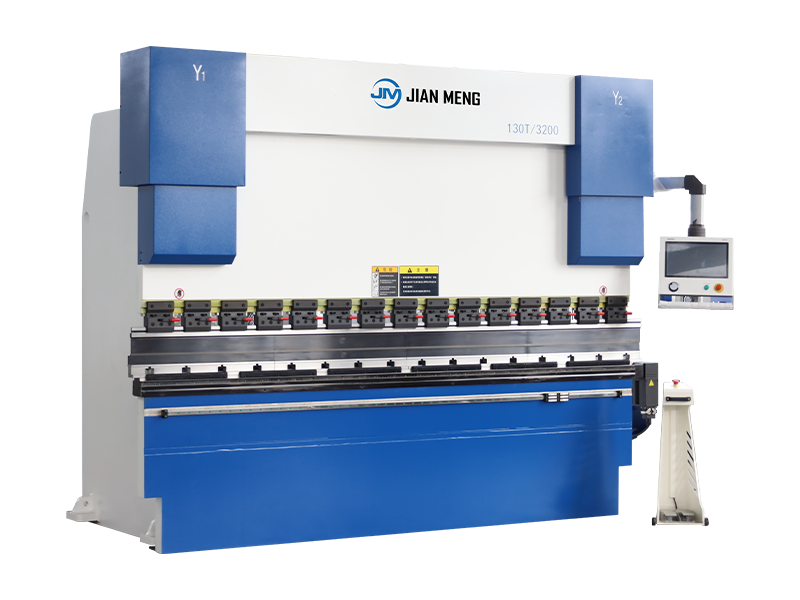
A CNC electro hydraulic synchronous press brake is a hydraulically driven sheet metal bending machine in which two independent hydraulic cylinders (designated Y1 and Y2) are governed by a closed-loop electro-hydraulic servo control system. Unlike older torsion-bar synchronisation designs that rely on a rigid mechanical twist bar to keep both sides of the ram in phase, the electro hydraulic variant uses proportional servo valves, high-resolution linear encoders and a dedicated CNC controller to continuously measure and correct ram position in real time.
The result is a machine that bends with near-identical force and angle on both ends of the workpiece — even across a 6-metre bed — without manual shimming or operator intervention.
 
This architecture sits between all-electric press brakes (which use ball-screw servo motors but are commercially limited to roughly 300 tonnes) and conventional open-loop hydraulic machines (which are powerful but suffer thermal drift during long production runs). The electro hydraulic synchronous design preserves the full tonnage range of hydraulics — from 40 tonnes to well beyond 1,000 tonnes — while delivering positioning precision in the ±0.005–0.02 mm band.


2. How the Electro Hydraulic Synchronous System Works

 
Understanding the control loop helps explain why this machine type outperforms older hydraulic designs in both consistency and energy efficiency.
 

2.1 The Three-Layer Closed-Loop Architecture

 
The servo-hydraulic system operates through three hierarchical stages:
 
Command layer. The CNC controller — typically a Delem DA-66T, DA-69T or ESA S660 — receives the part geometry (either programmed manually or imported from a 2D/3D CAD file). It calculates the target bottom dead centre (BDC) position, bending force curve and back-gauge coordinates for each step of the bend sequence. Analog voltage or current signals are then dispatched to the proportional servo valves.
 
Execution layer. The electro-hydraulic proportional servo valve (commonly a Rexroth 4WRKE-class unit with a response frequency ≥ 150 Hz) receives the command and dynamically adjusts oil flow and back pressure to each cylinder independently. This is the critical difference from torsion-bar machines: the Y1 and Y2 cylinders are fed through separate hydraulic channels, eliminating the forced-synchronisation error that a mechanical twist bar inevitably introduces — especially under eccentric loading conditions such as single-side short-edge bending.
 
Feedback layer. High-precision linear encoders (Heidenhain LC-series gratings with 0.5 µm resolution are widely specified) are mounted at both ends of the ram. They continuously report actual ram position back to the CNC at millisecond intervals. The controller runs a PID algorithm, compares the measured value with the target, and issues a correction signal — forming a fully closed loop.
 

2.2 Energy Efficiency Through Servo Pump Control

 
A conventional hydraulic press brake runs its motor-pump unit at constant speed throughout the entire cycle, even during rapid approach and dwell phases when no pressing force is required. In an electro hydraulic synchronous machine, the servo motor driving the hydraulic pump only delivers oil flow when the bending stroke demands it. During standby and rapid traverse, the pump idles at near-zero consumption.
 
Field data from multiple OEMs confirm an energy reduction of 30–50% compared with constant-flow hydraulic equivalents. The secondary benefit is less heat generation inside the hydraulic circuit: lower oil temperatures mean slower fluid degradation, which extends oil change intervals from roughly 2,000 hours to 4,000+ hours and reduces the frequency of seal replacements.
 

2.3 From Programming to Finished Part

 
A typical bending cycle on an electro hydraulic synchronous press brake proceeds as follows:
 
1. The operator loads the part program (or imports a DXF/DWG file via the CNC touchscreen).
2. The controller auto-calculates springback compensation, bend sequence and required tonnage based on material type, thickness and die opening.
3. The multi-axis back-gauge (X, R, Z1, Z2 — often 4 to 6 axes) positions the sheet automatically.
4. The ram descends under servo-controlled speed: fast approach transitions smoothly to pressing speed at the programmed deceleration point.
5. At BDC, the encoder verifies angle and position; any deviation triggers an immediate correction before the next stroke.
6. The ram returns, the back-gauge repositions for the next bend, and the cycle repeats.
 
The entire process — from first touch to final bend — can run unattended for dozens of parts in succession, with the closed-loop system maintaining dimensional consistency that would be impossible to achieve through manual operation.


3. Core Structural Components

 
Selecting a press brake is not just about comparing tonnage figures on a brochure. The quality of several sub-assemblies directly determines long-term accuracy and reliability.
 

3.1 Machine Frame

 
A proper frame is manufactured from thick, low-alloy steel plate using integrated welding construction, followed by a secondary stress-relief annealing treatment (typically 550–600 °C for several hours). This two-stage process ensures the frame does not distort under continuous heavy loading — a common failure mode in cheaper machines that skip the annealing step. After 10 or more years of production, a well-built frame should still hold its original geometric tolerance.
 

3.2 Hydraulic Cylinders & Servo Valves

 
The cylinders themselves are honed to a bore surface roughness of Ra 0.4 µm or better to ensure smooth piston travel and consistent sealing. The servo valves are the most cost-sensitive component: imported units (Rexroth, Parker, Hoerbiger) still dominate the high-performance segment, though domestic Chinese alternatives have improved considerably — with the import share for servo valves dropping from approximately 75% in 2024 to around 68% in 2025, according to Boxun Consulting's 2026 electro-hydraulic press brake industry report.
 

3.3 CNC Controller

 
The CNC is the "brain" of the machine. Leading controllers include:
 
• Delem DA-66T / DA-69T (Netherlands) — dominant in mid-to-high-range machines; supports 2D/3D graphical programming, automatic springback compensation and collision detection.
• ESA S660 / S700 (Italy) — widely used in European OEM machines.
• Cybelec ModEva (Switzerland) — known for advanced offline programming interfaces.
 
These systems typically account for 73.5% of the CNC-configured machine market in China, based on 2025 shipment data.
 

3.4 Back-Gauge System

 
A multi-axis back-gauge is essential for production efficiency. A 4-axis system (X, R, Z1, Z2) covers the majority of standard bending tasks; 6-axis configurations add additional fingers and controllable crowning for complex parts. Positioning tolerance on a well-maintained back-gauge should be within ±0.03 mm.
 

3.5 Crowning (Deflection Compensation) System

 
Any press brake bed will deflect slightly under full tonnage. Mechanical crowning (a set of adjustable wedges under the lower die) and hydraulic crowning (a series of small compensation cylinders along the bed) are the two common approaches. Hydraulic crowning responds faster and adapts automatically to varying tonnage — an important feature for shops that frequently switch between thin-gauge and thick-plate work.


4. Electro Hydraulic Synchronous vs. Other Press Brake Technologies

 
The press brake market offers several technology platforms. Each has a legitimate niche; none is universally superior. The table below summarises the key differences relevant to purchasing decisions.

Parameter Torsion-Bar Synchronous CNC Electro Hydraulic Synchronous All-Electric Servo
Ram positioning accuracy ±0.10 mm ±0.01–0.02 mm ±0.003–0.005 mm
Max commercial tonnage 1,000+ tonnes 1,000+ tonnes ~300 tonnes
Bending angle repeatability ±0.5° ±0.25° ±0.1°
Energy consumption Baseline 30–50% lower than baseline 50–70% lower than baseline
Eccentric load tolerance ≤ 10% of rated tonnage ≤ 30% of rated tonnage N/A (single-cylinder design)
Thermal drift Moderate; requires compensation Minimal with servo control None (no hydraulic fluid)
Typical price range (100T) USD 12,000–18,000 USD 18,000–30,000 USD 50,000–120,000
Best suited for Low-volume structural steel Medium- to high-volume precision bending High-volume thin-gauge electronics & enclosures

When torsion-bar is still acceptable. For job shops that bend mild steel brackets in low volume (under 50 parts per week) with angle tolerances of ±0.5° or wider, a torsion-bar machine remains a cost-effective option. The capital investment is lower, and operator skill can compensate for much of the inherent accuracy gap.
 
When all-electric makes sense. If the work is predominantly thin-gauge (under 6 mm), cycle times are short, and shops operate in temperature-controlled environments, all-electric machines offer a compelling precision and energy advantage — but at 2–4× the price of an electro hydraulic unit of similar bed length.
 
When electro hydraulic synchronous is the right call. For most fabrication environments that handle a mix of materials and thicknesses, run production shifts of 8+ hours, and require angle consistency tighter than ±0.3°, the electro hydraulic synchronous press brake offers the best balance of tonnage capacity, precision and operating cost.


5. Key Industries Driving Adoption


5.1 Automotive Manufacturing

 
The automotive sector accounted for 35.1% of global press brake demand in 2025 — roughly USD 218 million (P&M Market Research). Electro hydraulic synchronous press brakes are standard equipment for chassis brackets, battery enclosures for EV platforms, exhaust system components and seat frame assemblies. The shift toward high-strength steel (HSS) and aluminium in lightweight vehicle designs has tightened angle tolerances and increased demand for machines with real-time adaptive control.
 

5.2 Aerospace & Defence

 
Aerospace accounted for 16.1% of demand (USD 100 million) in 2025. The sector's defining requirement is traceability: every bend must be documented with force, position and angle data for quality audits. Electro hydraulic synchronous machines equipped with OPC-UA communication protocols and edge computing modules can log process parameters for every single stroke — a capability that is increasingly mandatory for AS9100 and Nadcap-certified suppliers.
 

5.3 New Energy & Infrastructure

 
New energy applications — photovoltaic mounting structures, wind turbine tower sections, lithium battery trays — generated 22.7% year-on-year order growth in 2025, making this the fastest-growing demand segment for press brakes. These applications often involve bending 25 mm+ high-strength steel with deflection compensation response times under 80 ms — requirements that only closed-loop electro hydraulic systems can reliably meet.
 

5.4 General Machinery & Shipbuilding

 
General machinery (26% share) and shipbuilding represent steady, high-volume demand for mid-range tonnage machines (200–800 tonnes). Shipbuilding in particular demands extra-long beds (4–6 metres) and the ability to bend marine-grade steel with uniform welding-prep bevels — applications where the electro hydraulic synchronous system's eccentric load tolerance (up to 30% of rated tonnage) provides a clear advantage over torsion-bar alternatives.


6. How to Specify the Right Machine

 
Selecting a press brake is an exercise in matching machine capability to the specific demands of your production environment. The following parameters form the core decision framework.
 

6.1 Bending Tonnage

 
Calculate the required force based on your maximum material thickness, tensile strength and die V-opening. A standard rule of thumb for mild steel (450 N/mm²) is approximately 8 tonnes per metre of bed length per millimetre of thickness with an 8×V die. Always reserve 10–20% tonnage margin for stainless steel or high-strength alloys, which require significantly more force.
 

6.2 Bed Length & Column Spacing

 
Standard bed lengths range from 2,000 mm to 6,000 mm, with custom options up to 9,000 mm for specialised applications (wind tower sections, marine panels). If your longest workpiece is 3,000 mm, specifying a 4,000 mm bed provides adequate margin without paying for unused capacity. Column spacing (the distance between the two side frames) must accommodate your widest flange dimension.
 

6.3 CNC Controller Selection

 
For shops producing fewer than 50 unique parts per week, a basic 2-axis controller (Delem DA-53T or equivalent) is sufficient. For higher mix environments, invest in a DA-66T or DA-69T class controller with graphical programming, 3D simulation and collision detection — the programming time savings alone typically justify the upgrade within 6–12 months.
 

6.4 Automation Readiness

 
If there is any possibility of integrating robotic part handling or automated tool changers in the future, specify the machine with the appropriate I/O interfaces and communication protocols (OPC-UA, Profinet or EtherCAT) from the outset. Retrofitting these interfaces later is significantly more expensive than factory-installed options.
 

6.5 After-Sales & Service Infrastructure

 
A press brake is a 15- to 20-year capital investment. Evaluate the manufacturer's spare parts availability, response time for on-site service and access to remote diagnostics. Machines equipped with IoT modules can transmit error codes and maintenance alerts to the OEM's service centre, enabling proactive support before a minor issue becomes a production stoppage.


7. Why JIANMENG for Electro Hydraulic Press Brakes

 
Jianmeng Intelligent Equipment (Taizhou) Co., Ltd. has been designing and manufacturing sheet metal fabrication equipment for over 30 years, with a product portfolio spanning press brakes, shearing machines, V-grooving machines, fibre laser cutting machines and forming machines.
 
Key differentiators:
 
• 50+ patents filed across press brake and forming machine technology, with 10+ new patents added annually.
• ISO 9001 certified quality management system with multi-stage in-process inspection protocols.
• An expert engineering team of 90+ specialists dedicated to R&D, backed by an 8,500 m² manufacturing facility producing 300+ machines per year.
• A global installed base of 3,500+ customers across Southeast Asia, South Asia, the Middle East, Europe, North America, South America and Africa.
• Customisation capability across equipment specifications, CNC controller brand and language, safety configurations and automation integration.
• Recent industry-academia collaboration with Jiangsu University of Science and Technology (JUST), reinforcing continuous technology advancement.
 
Jianmeng's electro hydraulic synchronous press brake series is engineered for fabricators who need consistent bending accuracy across high-mix, medium-to-high-volume production — without the capital expenditure of all-electric alternatives.


8. Final Considerations

 
The CNC electro hydraulic synchronous press brake has evolved from a premium option into the mainstream standard for professional sheet metal fabrication. Its combination of closed-loop precision, energy efficiency and tonnage versatility addresses the core challenges that most fabrication shops face: tighter angle tolerances, rising labour costs, mixed production schedules and increasing demands for process traceability.
 
For shops currently operating torsion-bar machines and considering an upgrade, the return-on-investment calculation typically centres on three factors: reduced scrap rates (fewer parts bent outside tolerance), faster setup times (CNC program storage versus manual dial-in), and lower energy bills (servo pump efficiency). For shops already running CNC hydraulic machines, the next upgrade step is adding IoT connectivity and adaptive process control to further reduce dependence on operator skill.
 
The press brake market is projected to grow steadily through 2032. Fabricators who invest in the right machine configuration today — matched to their specific material mix, part complexity and production volume — will be well positioned to compete in an environment where precision, speed and traceability are no longer optional.


Prev:None
◇◇ Related content ◇◇
◇◇ Related products ◇◇

More Info? Get In Touch

CONTACT
Email:

jeanie@jianmeng.com

Phone:

+86 19805122954