Vertical Laser Composite Grooving Machine: Cut, Shear And Groove In One Setup
Release time:2026-11-02
Visits:1
One machine, three processes
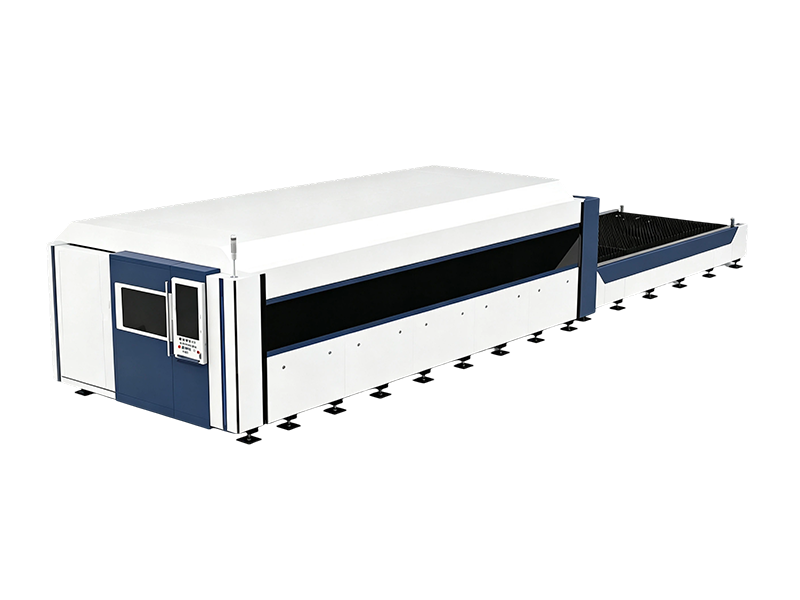
The vertical laser composite grooving machine is built on a simple observation: most sheet metal parts need cutting, shearing and grooving — and doing them on three separate machines means moving the sheet between three workstations. A composite machine puts all three processes in one unit, with one loading.
The machine holds the sheet vertically, cutting it to shape with a
fiber laser, shearing it where needed, and cutting V-grooves along the bend lines for clean right-angle bends. Because everything happens in one setup, the sheet is handled once instead of three times. That is where the value is concentrated.
What the machine actually does
Let's break the "3-in-1" into the three operations.
- Laser cutting. The fiber laser cuts the sheet to the finished outline, so there is no separate cutting machine in the workflow.
- Shearing. The machine shears straight edges cleanly, covering the straight cuts that lasers are not always the fastest option for.
- V-grooving. It cuts precise V-grooves along the bend lines, so the sheet folds into sharp, accurate right angles.
A vertical machine holds the sheet upright, which keeps the footprint small and makes large sheets easier to handle.
The savings are the story
Shops are not usually sold on a machine by clever integration alone — they buy the numbers. The composite machine delivers on the things that show up in the workshop's ledger.
Workspace. Because three machines become one, the machine can save up to 50% of the floor space the separate machines would occupy.
Handling. Material is loaded once and processed through cut, shear and groove without being shuffled to another machine. Less moving means less time and less damage.
Productivity. One loading, multiple functions — the machine simplifies the workflow and raises throughput on parts that would otherwise queue at three stations.
The specification that matters
|
Parameter |
Typical value |
|
Maximum plate thickness (stainless) |
6.0 mm |
|
Minimum plate thickness |
0.4 mm |
|
Grooving speed |
Up to 120 m/min |
|
Repeatability |
±0.02 mm |
|
Minimum V-groove distance from edge |
8.0 mm |
|
Minimum laser cutting distance from edge |
25 mm |
|
Table flatness |
0.03 mm |
|
Laser power |
1.5 to 3.0 kW |
The two "distance from edge" numbers deserve attention. If your parts need a groove or a cut very close to the sheet edge, confirm the machine can reach it before you buy.
What to look for in build quality
A composite machine is only as good as its parts. Check the named components, because they tell you how the machine is put together.
- Fiber laser source — brands like MAX signal a serious laser.
- Laser cutting head — names such as WSX.
- Controller and servo motors — EASYCAT is a common choice in this class.
- Linear guides — heavy guides such as TBI handle the loads.
- Cables and contactors — quality suppliers like IGUS and Schneider.
When a manufacturer names real suppliers rather than saying "premium components", you can trust the build more.
Jianmeng's vertical laser composite machine
Jianmeng's vertical laser & V-grooving composite machine (model SVM series) integrates laser cutting, shearing and V-grooving in one compact unit. It processes stainless steel and aluminium alloy at grooving speeds up to 120 m/min with ±0.02 mm repeatability, powered by 1.5 to 3.0 kW fiber lasers, and is built with components from MAX, WSX, TBI and Schneider among others. Drawing on 30 years of machine building and more than 3,500 customers worldwide, Jianmeng sizes the machine to your material, plate thickness and edge-distance requirements.
Frequently asked questions
What does "laser composite grooving machine" mean?
It means the machine combines multiple processes — typically laser cutting, shearing and V-grooving — in a single unit, so a sheet is processed through all of them in one loading.
How much space does it save?
Because three machines are combined into one, shops commonly report savings of up to 50% of the floor space the separate machines would need.
What thickness can it handle?
Typically 0.4 to 6.0 mm in stainless steel, depending on laser power and configuration.
Why hold the sheet vertically?
A vertical stance reduces the machine's footprint and makes loading and handling large sheets easier than on a wide horizontal table.




 English
  中文
中文  Arabic
  Russian
  Spanish
  Portuguese
  French
  German
  Hindi
Hindi  Thai
Thai  Vietnamese
  Khmer
Khmer  Italian
  Turkish
  Korean
  Belarusian