The Ultimate Guide To Laser Cutting Machines: A Complete Analysis Of Principles, Applications And Selection
Release time:2026-07-08
Visits:226
In today's field of precision manufacturing and creative processing, laser cutting technology is undoubtedly a brilliant star. As a piece of equipment that works by using high-energy-density laser beams, laser cutting machines have completely transformed the production methods of numerous industries, from heavy industry to light industrial creativity, with their unparalleled precision and efficiency. It is not just a machine, but also one of the core driving forces promoting the intelligent and refined development of modern manufacturing. This article will provide you with an in-depth yet accessible analysis of the working principles of laser cutting machines, their wide-ranging applications, and how to make a wise choice based on your needs.
I. How Do Laser Cutting Machines Work? Revealing Their Core Principles
The essence of laser cutting is to irradiate the workpiece with a focused high-power-density laser beam, so that the material at the irradiated area quickly reaches its melting point, boiling point, or ignition point. At the same time, a high-speed airflow (such as oxygen, nitrogen, or compressed air) coaxial with the beam is ejected from the cutting head to blow away the melted or vaporized material, thereby achieving cutting. The entire process is precisely controlled by a computer numerical control system to ensure the cutting path is completely accurate. This non-contact processing method avoids tool wear and mechanical stress, making it particularly suitable for handling complex shapes and high-hardness materials.
II. Ubiquitous Applications: Laser Cutting Machines Empowering All Industries
The versatility of laser cutting machines keeps expanding their application boundaries. They can efficiently process a wide variety of materials, including various metals (such as carbon steel, stainless steel, aluminum alloy), plastics, wood, fabrics, and even composite materials.
Cornerstone of Industrial Manufacturing: In automobile manufacturing, they are used to cut body frames and precision parts; in the aerospace field, they process high-strength alloy components; in the electronics industry, they perform precision cutting of circuit board housings and heat sinks.
Stage for Commerce and Creativity: The advertising signage industry uses them to produce exquisite metal characters and acrylic signs; the furniture and decoration industry relies on them to create metal screens with complex patterns and wooden artworks; even in the fashion field, laser cutting is used for precise trimming and hollow-out design of leather and textiles.
Specialized Professional Applications: In medical device manufacturing, they cut surgical instruments and implants; in the packaging industry, they produce customized molds and samples.
III. Why Choose Laser Cutting? Unmatched Outstanding Advantages
Compared with traditional cutting methods, laser cutting has decisive advantages:
Extreme Precision and High-Quality Cuts: It can achieve millimeter-level or even finer cutting, with narrow kerfs, smooth cuts, and no need for secondary processing.
Exceptional Production Efficiency: It features fast cutting speed, with remarkable advantages especially in thin-plate processing, and can work continuously for long hours, greatly boosting production capacity.
Unparalleled Flexibility and Automation: It can easily switch to cutting any complex shape through software, realizing flexible production of small batches and multiple varieties. Integrated with automated systems, it can achieve unmanned operation.
Wide Material Adaptability: One machine serves multiple purposes, reducing equipment investment and process switching time.
Clean and Eco-Friendly Non-Contact Processing: No tool wear, reduced mechanical deformation of materials, and a cleaner working environment.
IV. Core Technologies and Components: The Inner World of a Laser Cutting Machine
A laser cutting machine mainly operates through the coordination of the following key parts:
1. Laser: The heart that generates the laser beam, whose type directly determines the processing capability of the equipment.
2. Beam Transmission and Focusing System: Like nerves and lenses, it guides and focuses the laser to an extremely high power density.
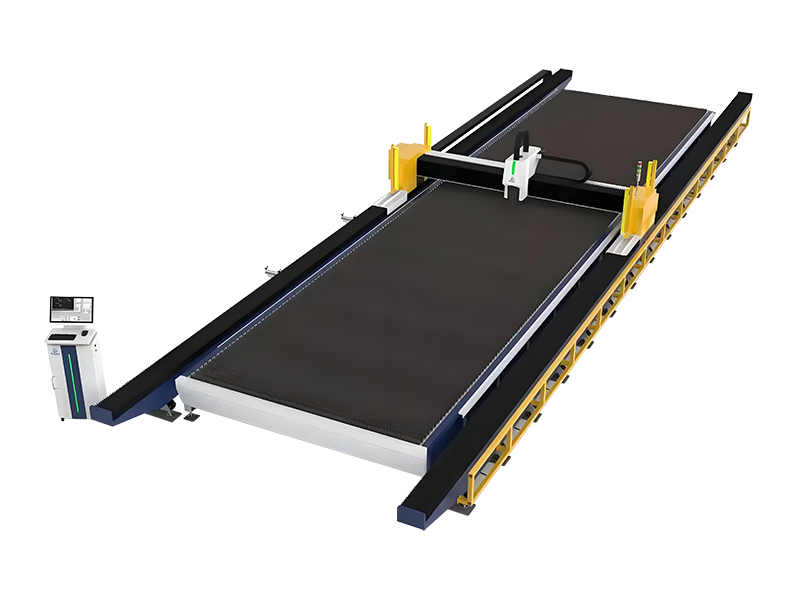
3. CNC Motion System and Worktable: The hands and feet that precisely control the movement of the cutting head or workpiece along a predetermined trajectory.
4. Auxiliary Gas System: Provides gas for cutting, which directly affects the cutting effect and speed.
5. Control System and Software: The brain of the equipment, responsible for graphic processing, path planning, and overall machine coordination.
Among them, focal position control, auxiliary gas parameter adjustment, and a stable numerical control system are the key technologies to ensure cutting quality and efficiency.
V. Analysis of Main Types: CO2, Fiber and Ultraviolet Laser Cutting Machines
Different types of laser cutting machines are suitable for different materials and scenarios:
CO2 Laser Cutting Machine: Uses gas as the medium, excels at cutting non-metallic materials (such as acrylic, wood, fabrics) and thin metal plates, with mature technology and wide applications.
Fiber Laser Cutting Machine: Adopts a solid-state fiber laser with extremely high photoelectric conversion efficiency, and is especially good at cutting metal materials. It has significant advantages in metal processing in terms of speed, energy consumption, and maintenance cost, and has become the mainstream in the current market.
Ultraviolet Laser Cutting Machine: Belongs to cold processing with a very small heat-affected zone, and is mainly used for ultra-fine processing, such as precision cutting and marking of flexible circuit boards, glass, ceramic sheets, and certain polymer materials.
VI. How to Choose the Right Laser Cutting Machine for You? Key Consideration Factors
Faced with numerous options, you can make a decision based on the following points:
1. Core Processing Materials and Thickness: This is the primary factor. Clarify the main types of materials you cut (metal or non-metal) and their maximum thickness, which directly determines the type and power of the required laser.
2. Requirements for Processing Precision and Speed: Different industries have different priorities for precision and efficiency, so you need to clarify your core needs.
3. Production Scale and Automation Requirements: For mass production, consider the stability of the equipment and supporting automated loading and unloading; for small-batch and multi-variety production, focus more on the equipment's operational flexibility and fast switching capability.
4. Overall Investment and Operating Budget: In addition to the equipment purchase cost, you also need to consider long-term operating costs such as power consumption, gas consumption, and maintenance.
All in all, a
laser cutting machine is an indispensable tool in modern manufacturing. Understanding its working principles, clarifying your own needs, and selecting the appropriate type will significantly enhance your production capacity and product competitiveness, giving you a strong boost on the path of precision and efficiency.




 English
  中文
中文  Arabic
  Russian
  Spanish
  Portuguese
  French
  German
  Hindi
Hindi  Thai
Thai  Vietnamese
  Khmer
Khmer  Italian
  Turkish
  Korean
  Belarusian