That simple difference solves two practical problems that every shop knows. The first is floor space: a vertical machine stands in a fraction of the footprint a horizontal table needs. The second is handling: on a vertical machine the operator stands the sheet against the work plane instead of wrestling a large flat panel onto and off a table. For shops working big sheets, that makes a real difference to how easily parts move through the line.
Do not let the orientation fool you. The vertical machine cuts exactly the same kind of groove, for the same reason. A V-groove along the bend line removes material where the fold happens, so the sheet bends into a clean right angle with less force and less springback. The customers are the same too: stainless steel cabinets, aluminium curtain walls, elevator panels, high-end metal doors — anything that needs a sharp, seamless corner.
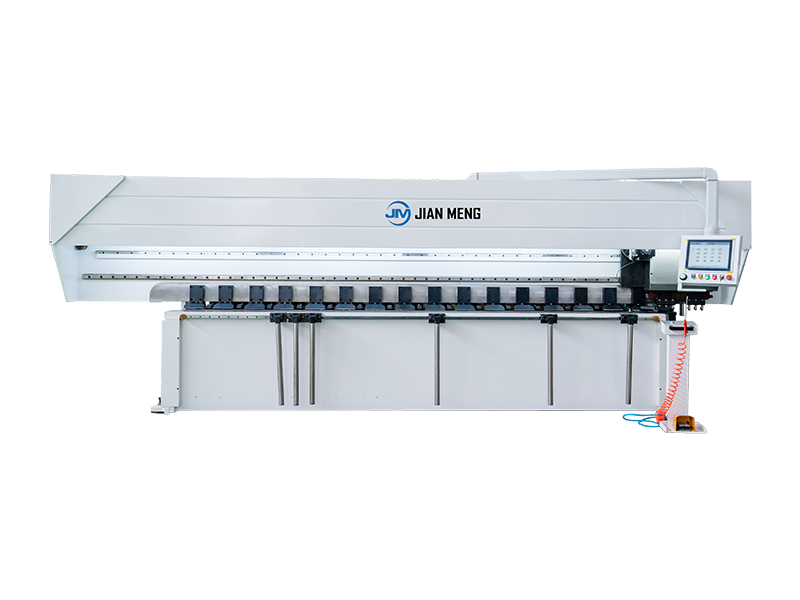
What changes with the vertical design is how the machine is built. The work plane stands upright, the cutter travels across it, and the sheet is positioned and held against that plane. If the machine uses a reciprocating cutter, it can groove back and forth rapidly, which pushes throughput up on parts that run in volume.
|
Point |
Vertical V-grooving machine |
Horizontal V-grooving machine |
|
Floor footprint |
Smaller |
Larger |
|
Sheet handling |
Sheet stands upright |
Sheet lies on a table |
|
Grooving speed |
Up to 120 m/min with reciprocating heads |
Up to 120 m/min |
|
Typical plate thickness |
0.4 to 5.0 mm |
0.4 to 5.0 mm |
|
Repeatability |
±0.02 mm |
±0.02 mm |
|
Best for |
Space-constrained shops, large sheets |
Very large tables, certain workflows |
Both are precision machines with comparable accuracy. The choice is about your layout, your sheet sizes and how your team prefers to load work.
Accuracy that decides the corner
Whatever the orientation, the quality of the machine shows in two numbers: how accurately it positions the groove and how flat the work plane is. A vertical machine holds repeatability around ±0.02 mm and work-plane flatness around ±0.03 mm. Because the groove depth sets the remaining material at the bend line, that accuracy is what turns a rounded corner into a sharp one, part after part.
On reciprocating designs, the cutter shuttles back and forth across the sheet in quick passes. Combined with high traverse speeds, this keeps cycle times short even though the machine is compact.
Checking the distance from the edge
One specification buyers of vertical machines should look at closely is the minimum V-groove distance from the sheet edge. On many vertical machines that figure sits around 10 mm as standard, with custom options available for tighter requirements. If your parts call for a groove very close to the edge, confirm the machine can hit it before you buy.
Jianmeng's vertical grooving line
Jianmeng builds the full spread of V-grooving machines — horizontal, vertical, reciprocating vertical, and vertical laser composite — and introduced its first gantry-style CNC machine in 2008 before pioneering automatic four-side grooving in 2015. Vertical machines from Jianmeng process stainless steel and aluminium at up to 120 m/min with the accuracy the corner quality demands. With more than 3,500 customers worldwide and 30 years of machine-building behind the designs, we match the machine orientation and table size to your shop floor and your parts.
Frequently asked questions
What is the difference between a vertical and a horizontal V-grooving machine?
Both cut the same V-groove for clean bends. A vertical machine holds the sheet upright, taking less floor space and making large-sheet handling easier; a horizontal machine lays the sheet flat on a large table.
Can a vertical machine process thick stainless steel?
Yes, within its range — typically 0.4 to 5.0 mm. For the thickness your parts need, check the machine's spec against your thickest sheet.
Is the vertical machine as accurate as a horizontal one?
Yes. Both designs hold repeatability around ±0.02 mm and plane flatness around ±0.03 mm. Orientation does not reduce accuracy.
What is a reciprocating vertical grooving machine?
A vertical machine whose cutter shuttles back and forth rapidly across the sheet, which raises throughput on parts that run in large volumes.




 English
  中文
中文  Arabic
  Russian
  Spanish
  Portuguese
  French
  German
  Hindi
Hindi  Thai
Thai  Vietnamese
  Khmer
Khmer  Italian
  Turkish
  Korean
  Belarusian